Partnership to develop lower-emission titanium production
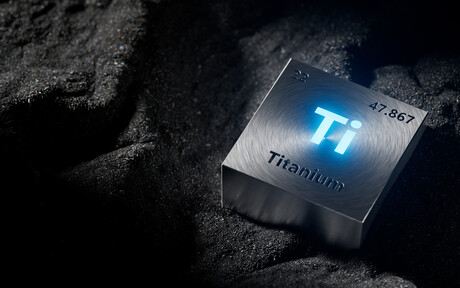
Murdoch University researchers are working to transform how titanium metal is produced by developing a more efficient, lower-cost and lower-emission alternative to current methods.
Traditional titanium production relies on the Kroll process, a multi-step method which generates waste and can be costly and energy intensive.
London-based Empire Metals has commissioned the university’s Extractive Metallurgy Hub to help develop an advanced process for converting titanium dioxide (TiO2) into titanium metal using molten salt electrolysis, powered by renewable energy.
Molten salt electrolysis is a process that uses electricity in a high‑temperature liquid salt bath to strip oxygen from titanium dioxide and produce pure titanium metal directly.
“This is about rethinking how we produce one of the world’s most important strategic metals,” said Professor Aleks Nikoloski, who leads the Extractive Metallurgy Hub at the Rockingham campus.
“We are working to demonstrate that titanium can be produced more efficiently and with a significantly reduced environmental footprint by moving away from traditional, energy-intensive processes.”
The TiO2 will be sourced from Empire Metals’ Pitfield Project, located in WA’s Mid-West.
“WA has one of the world’s most powerful mining sectors, but much of that value is still realised overseas, where raw materials are processed into finished products,” Nikoloski said.
“This work highlights a clear opportunity to shift more of that value chain locally — to not only extract critical minerals, but to process and refine them in the state, creating new capability, new industries and greater economic resilience.
“By developing advanced processing technologies locally, WA can position itself not just as a supplier of resources, but as a global leader in how those resources are transformed into the materials of the future.”
The research program is expected to run through 2026 and aims to deliver both proof-of-concept results and a pathway for scaling the technology to pilot and commercial operations.
Daikin DeVap evaporator range
Daikin Australia has introduced its DeVap evaporator range, designed specifically for Australian...
igus E2.1 range with igumid CG LW
The igus E2.1 energy chain series is switching to the recycled material known as igumid CG LW,...
Vertiv CoolLoop Trim Cooler
The Vertiv CoolLoop Trim Cooler is designed to operate with fluctuating water temperatures...