Tassie off-grid pod selected as water prize semi-finalist
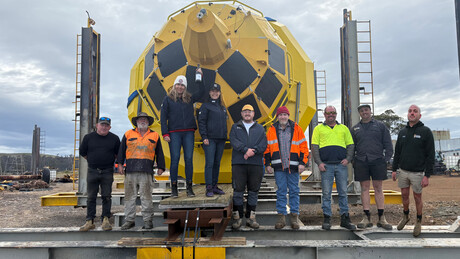
A pendulum-shaped, off-grid pod floating off Tasmania’s coast has been named as a contender in an international innovation competition to solve global water security.
Developed by Queensland company Blue Carbon, the oPod Aqua has been selected as one of 20 category semi-finalists from an initial pool of 674 teams across 86 countries in the XPRIZE Water Scarcity competition, a $119 million, five-year global initiative focused on enabling widespread access to clean water through reliable, affordable and sustainable seawater desalination technologies.
Tethered in Okehampton Bay near Orford, the Australian-designed, self-powered desalination unit uses wave, solar and wind energy to convert seawater into drinking water. Most of the 26 m-long oPod sits beneath the surface, with only a 5 m buoy-shaped structure visible above water.
Unlike power-hungry, land-based desalination systems, the oPod Aqua works totally off-grid. Using wave action, it draws water from deep below the surface and then desalinates it, using onboard solar panels and wind turbines. The prototype unit can produce 100 L/hour and stores more than 6000 litres in onboard tanks.
Leftover brine is only slightly saltier than the surrounding seawater and is rapidly diluted in open water. The oPod’s upwelling flows further mix the discharge, preventing the ‘salt hotspots’ often associated with traditional desalination.
Next-generation units are now in development, expected to produce 20,000–50,000 litres per day from a single unit by replacing electric pumps with wave-driven flow.
The oPod Aqua is part of a broader suite of ocean-based technologies being developed by Blue Carbon — co-founded by Dr Ana Novak and Eva Chiu.
In 2025, the oPod Aqua was recognised as one of Queensland’s leading innovators in the Brisbane Lord Mayor’s Business Awards and in 2026, it won both the main prize and people’s choice award in the KPMG Nature Positive Challenge.
“At the heart of the system is Blue Carbon’s passive fluidic logic — a mechanical computer that removes the need for complex sensors and controls,” Novak said. “With fewer moving parts, it’s more durable, easier to maintain and lowers the cost of water.”
Blue Carbon is the only Australian entry in the award’s systems and innovation category; there are two other Australian semi-finalists in the novel materials and method category.
“We acknowledge the outstanding contributions of the team supporting the deployment. Their expertise, commitment and hands-on support have been instrumental to the project’s success,” Novak said.
“This includes the teams from BLW Marine Management, Rock Electrical & Solar, Marine Solutions and West Marine, whose efforts and collaboration were critical in making the deployment possible.”
“Blue Carbon also extends its appreciation to all supporting crew and contractors whose dedication and collaboration helped make the deployment a success.”
For more on the XPRIZE Water Scarcity competition, visit the website.
AWA celebrates National Water Week 2026
Hosted by Australian Water Association, National Water Week has kicked off, with the theme...
Emergency crises hub launched for Asia–Pacific
The hub can dispatch a fully trained team and equipment at a moment's notice to deliver clean...
Long-term water security project proposed for Hunter region
The proposed project will replace a 12 km section of the CTGM between Brookfield Tunnel and Burmi...