Biochar used for solar water purification

A new study has developed a hybrid solar evaporator that uses biochar-doped hydrogel to turn sunlight into vapour more efficiently while improving water transport and reducing heat loss.
The research team from Harbin Institute of Technology (Shenzhen) developed the hybrid hydrogel by incorporating sorghum straw biochar into a polyzwitterionic hydrogel. The result is a soft, porous, water-rich material that can absorb sunlight, localise heat at the evaporation surface, and continuously deliver water to that surface for rapid evaporation.
“Solar interfacial evaporation is attractive because it uses clean solar energy directly at the water–air interface, but the material must do several things well at the same time,” said corresponding author Dr Wenzong Liu. “Our work shows that biochar can help hydrogels absorb light, manage heat, transport water and activate water molecules through one integrated design.”
Hydrogels are known for their three-dimensional water-loving networks, which can hold and move water efficiently. However, many hydrogels have weak photothermal conversion, meaning they do not absorb and convert sunlight into heat efficiently enough. Biochar, a carbon-rich material made from biomass, provides strong light absorption, low cost, chemical stability and abundant surface functional groups.
In this study, the researchers prepared biochar from sorghum straw through pyrolysis, acid washing, ball milling and sieving, then embedded it into the hydrogel network. The addition of biochar turned the hydrogel from transparent to black and greatly enhanced its optical performance. The researchers said the hybrid hydrogel maintained more than 95% light absorption across a broad solar spectrum, while the biochar itself showed over 98% absorption in the visible light range.
The researchers stated the material’s structure also changed in useful ways. Scanning electron microscopy showed that biochar incorporation produced a denser and rougher three-dimensional pore network. These smaller, more uniform pores increased internal light scattering and extended the light path inside the material, allowing more solar energy to be captured. At the same time, the pore structure supported capillary-driven water transport.
Under one-sun irradiation, the hybrid hydrogel reached a surface temperature of 41.1°C, while the bulk water beneath it rose only to 29.3°C, showing that heat was concentrated at the evaporation interface rather than being wasted in the surrounding water. This improved heat localisation led to an evaporation rate about 1.87 times higher than that of the hydrogel without biochar.
The study also revealed an important non-photothermal mechanism. Biochar surface groups such as hydroxyl, amino, carboxyl and carbonyl groups interacted with water molecules and the hydrogel network, changing the hydrogen-bond structure of water inside the material. This increased the amount of ‘intermediate water’, a state of water that requires less energy to evaporate than ordinary free water.
As a result, the hybrid hydrogel reduced the equivalent evaporation enthalpy to lower than that of the control hydrogel. In saline water, the hybrid hydrogel also showed improved swelling and water transport, reaching a saturated water content of 520% and helping sustain water supply during evaporation.
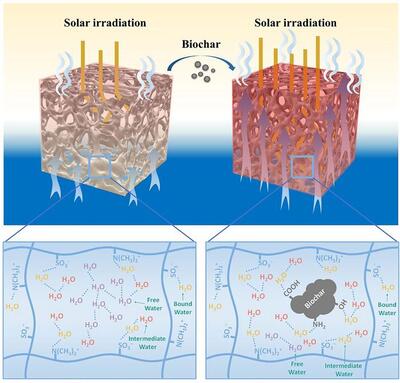
“The key finding is that biochar is not only a solar absorber,” Liu said. “It also regulates the hydrogel’s pore structure and the state of water molecules. This dual pathway explains why the evaporation performance improves so significantly.”
The findings, published in Biochar, provide insight into how low-cost biomass-derived materials can be used to design next-generation solar evaporators. By combining photothermal enhancement, heat-loss control, water transport, and water molecule activation, the biochar-hydrogel strategy could support future desalination and water purification technologies, especially in saline or resource-limited environments.
Long-term water security project proposed for Hunter region
The proposed project will replace a 12 km section of the CTGM between Brookfield Tunnel and Burmi...
Desalination marine works conclude at Belmont
Hunter Water has officially completed all major marine construction works for the Belmont...
$22m raised to improve remote water monitoring on farms
The rugged sensors and near real-time satellite connectivity let producers keep an eye on tanks,...