Smart stormwater system removes harmful pollutants
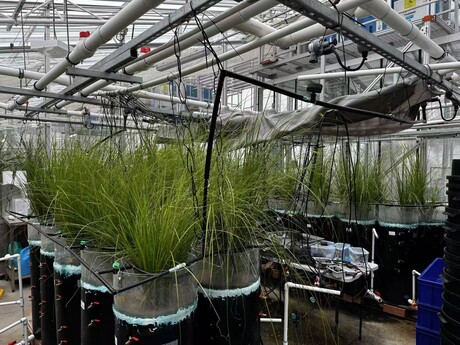
Researchers from UNSW Sydney have developed a smart stormwater treatment system that can automatically adapt to changing weather conditions, significantly improving its ability to remove harmful pollutants before they reach the environment.
The work is designed to reduce the ecological impacts that can be caused by polluted stormwater reaching streams, rivers and coastal waters — including increased algae blooms, reduced oxygen availability for fish and other aquatic animals, and the threat of toxic materials entering the food chain.
“Every time it rains, water washes across our roads, rooftops and footpaths before flowing into drains, creeks and rivers,” said lead researcher Jiadong Zhang. “Along the way it picks up a cocktail of pollutants — everything from fertilisers and pesticides to pharmaceuticals, plastics chemicals and contaminants released by vehicles.
“Some of these are toxic even in small amounts, while other pollutants can overwhelm natural systems in large enough quantities even if they are not individually toxic.”
To combat the problem, the team from UNSW has combined nature-based stormwater treatment with sensors, automated controls and weather forecasts to create what is believed to be the first adaptive real-time control system designed to improve pollutant removal in stormwater biofilters.
The work, supported by an Australian Research Council Discovery Early Career Researcher Award, found the technology consistently removed more pollution than conventional systems, increasing removal of many organic contaminants from around 76% to almost 90%.
Making rain gardens smarter
Across Australia, many parks, streets and road verges already contain stormwater biofilters — known as rain gardens. These landscaped areas use soil, plants and naturally occurring microbes to clean polluted runoff before it enters rivers, lakes and the ocean.
While highly effective, they have one limitation: they are passive.
Once stormwater enters a conventional biofilter, the system has little ability to respond to changing rainfall conditions. Heavy storms can overwhelm the system, while long dry periods can create conditions that are less effective at breaking down certain pollutants.
First author Zhang, a recent PhD graduate in UNSW’s School of Civil and Environmental Engineering, said the growing complexity of urban pollution means stormwater treatment systems need to become smarter.
“Because of human activities, there are now a lot of pollutants in stormwater, including nutrients, but also a growing group of emerging contaminants such as PFAS and other chemicals that are increasingly being detected in urban runoff,” he said.
“Nature-based systems like wetlands and rain gardens can remove many of these pollutants, but they are passive systems. During large or frequent rainfall they can become overloaded, leading to inconsistent treatment.
“That’s why we’re introducing sensors and controllers to actively regulate how these systems operate, so they can provide much more consistent treatment.”
How does the smart stormwater system work?
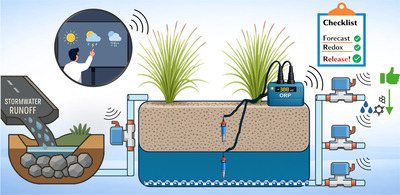
Rather than allowing water to simply flow through the biofilter, the UNSW stormwater system continuously monitors conditions inside the filter using sensors that measure factors such as soil moisture and redox potential — an indicator of the chemical environment that influences how effectively microbes break down pollutants. At the same time, the system runs continuous analysis of Bureau of Meteorology rainfall forecasts.
If heavy rain is expected, automated valves gradually release stored water before the storm arrives, creating space for the incoming runoff. If conditions inside the biofilter are already ideal for removing pollutants, the system can instead hold water longer to maximise treatment.
“It’s a bit like giving a rain garden the ability to think ahead,” Zhang said.
“The system has two layers of control. One layer monitors what’s happening inside the biofilter, including soil moisture and the conditions that help remove pollutants. The second layer uses weather forecasts to decide whether we should keep water inside the system or gradually release it before the next rainfall.
“Together, those two layers allow the system to automatically adapt to changing conditions without needing people to manually control it.”
(Click to enlarge)
Adapting to the changing weather
To evaluate the technology, the UNSW-led international research team — including Dr Kefeng Zhang and Professor Denis O’Carroll at UNSW, Dr Veljko Prodanovic from the Institute for Artificial Intelligence Research and Development of Serbia, and Professor David McCarthy from Queensland University of Technology and the University of Guelph — built identical laboratory biofilters and recreated 11 real rainfall events with varying storm sizes and dry periods.
They compared conventional biofilters with the new adaptive system using stormwater containing nutrients, suspended solids, and 10 representative organic contaminants found in urban runoff. The smart system consistently outperformed conventional biofilters.
It was particularly effective at removing pollutants that naturally break down in oxygen-rich conditions, while also improving removal of common pollutants such as nitrogen and organic carbon. Importantly, it continued to outperform conventional systems even when weather forecasts were imperfect, demonstrating resilience under real-world conditions.
Some highly persistent contaminants remained difficult to remove — a challenge shared by all current biofilter technologies — but the adaptive system still produced more reliable treatment across a wide range of rainfall conditions.
Beyond improved water quality
The researchers said the benefits extend well beyond improving water quality.
Stormwater carries pollutants directly into rivers, estuaries and coastal waters, where they can affect aquatic ecosystems. By capturing more of those contaminants before they leave urban areas, smarter stormwater infrastructure could contribute to healthier waterways and support long-term efforts to restore urban rivers.
Gradually releasing stormwater could also help reduce erosion caused by sudden surges of runoff during heavy rainfall. In addition, the team said the technology could complement initiatives aimed at creating cleaner, more swimmable urban waterways.
“Most people think stormwater is largely unpolluted because it is cleaner than wastewater, but that’s not entirely accurate,” Zhang said. “Rain gardens aren’t just there to look good — they remove a lot of pollution. By combining them with modern sensing technology, we’re transforming them from passive systems into active systems that can perform much more effectively.
“Ultimately, if we can stop more pollutants entering rivers and the ocean, that benefits the environment, wildlife and the communities that use those waterways.”
Looking to the future of stormwater treatment
Although the research has so far been demonstrated under laboratory conditions, the team believes the technology is now approaching the stage where it can be tested more broadly in the field.
Future work will focus on long-term operation using real stormwater, improving sensor durability and integrating the control system into existing stormwater infrastructure. The researchers are also exploring how similar sensing technologies can support broader monitoring of nature-based water treatment systems.
If successful, the approach could help cities improve water quality without replacing existing stormwater infrastructure. Instead, it would allow many existing biofilters to be upgraded with sensors, automated valves and intelligent control systems that adapt continuously to changing weather.
The UNSW Sydney research was published in Water Research.
SiteHive Weather monitoring device
The system combines onsite weather monitoring with the SiteHive Enviro platform, creating a...
Hach NP6000sc Phosphate Analyser
The phosphate analyser is designed specifically for utilities encountering issues with data...
Emerson Ovation AI-enabled virtual advisor
The Emerson Ovation AI-enabled Virtual Advisor is a GenAI advisor integrated into an...