Digitising sustainability using AI on water infrastructure project
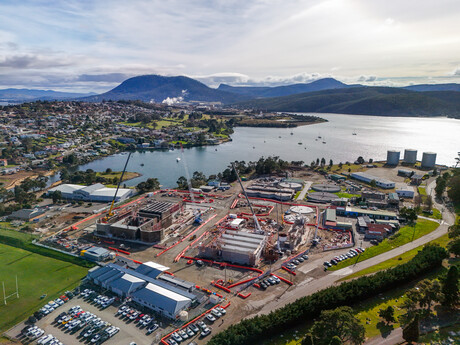
Project: Selfs Point Sewage Transformation Project, TasWater
The challenge of managing sustainability at scale
Infrastructure projects pursuing formal sustainability ratings face a common problem: the evidence is everywhere and the system to manage it rarely exists. Evidence sits across spreadsheets, shared drives, emails and consultant reports, while one or two people carry the burden of tracking dozens of interlocking requirements across a multi-year delivery program.
For the Selfs Point Sewage Transformation Project (STP) Upgrade in Hobart, a significant water infrastructure project delivered for TasWater under the CDO Alliance, this challenge was not just an operational inconvenience. As the project is pursuing a formal infrastructure sustainability rating through the Infrastructure Sustainability Council (ISC), the integrity of the evidence chain directly determines the credibility of the rating outcome. Poor data management means missed criteria, rework, risk and an inability to demonstrate accurate sustainability performance for the project.
The question the project team asked was simple: could a purpose-built digital management system, integrated with AI, do this better?
Building the system: a three-layer work management ecosystem
The answer took the form of a bespoke work management ecosystem built in Monday.com, one of the first implementations of its kind for an Australian infrastructure project. The approach, however, is not platform-dependent and can be configured in comparable work management tools such as Airtable, Smartsheet, Microsoft Power Platform or Notion. This makes it a transferable model for any organisation already working within a preferred digital environment.
The system is structured across three functional layers: governance, delivery, and reporting and AI. Together, these layers connect sustainability criteria to evidence, workflow and accountability in a single, auditable environment.
At the governance layer, a rating register maps all applicable sustainability criteria to their status, target score, evidence requirements and assigned team members. Criterion boards track the state of each submission, from ‘not started’ through to evidence-locked, with automated reminders and escalation workflows reducing the risk of requirements falling through the gaps.
The delivery layer captures subcontractor and project team data through integrated webforms and API connections, removing the manual transcription step that introduces errors in conventional systems. Energy, water, materials and waste data flows directly into structured boards, feeding three live sustainability dashboards for Energy and Carbon, Water, and Resource Efficiency. This means senior stakeholders and asset owners are not waiting for end-of-project reports to understand sustainability performance; the data is visible, current and decision-ready throughout delivery.
That real-time data infrastructure also has value beyond the project itself. As Australian organisations navigate mandatory climate-related financial disclosure under AASB S2, the ability to capture, structure and report environmental performance data at the project level strengthens the quality and auditability of disclosures at the organisational level. For asset owners such as TasWater, systems that generate structured, evidence-backed sustainability data as a natural by-product of project delivery support both ratings submissions and broader regulatory obligations.
Integrating AI into sustainability management
The reporting and AI layer is where the approach breaks genuinely new ground.
The project’s Sustainability Digital Management Plan (SDMP) formalises an approach that had not previously been documented for a formally rated infrastructure project: the use of AI to generate draft criterion narratives, with manual review and governance retained throughout. Each criterion response uses a dual-column format, with an AI-generated draft alongside a manually reviewed and approved version.
This structure preserves human accountability, which the rating framework requires, while significantly reducing the time needed to produce technically accurate, well-structured submissions. The approach is also transferrable. Any organisation using a structured work management system can adopt the same logic if it supports data columns, document links and review workflows.
Beyond criterion narrative drafting, the AI layer provides semantic search across the evidence repository, enabling team members to locate relevant documents without navigating complex folder structures. It also helps flag anomalies in data, such as energy consumption figures that fall outside expected ranges relative to construction milestones, before they propagate into formal submissions or external reports.
The result is a system that does not replace sustainability expertise, but amplifies it. The sustainability manager spends less time on administration and more time on analysis, quality assurance and strategic decision-making.
What it has delivered on Selfs Point
The Selfs Point STP Upgrade has achieved a strong sustainability performance record, supported directly by the digital management system’s ability to capture and verify evidence at the point of generation. Key outcomes to date include:
- 23% replacement of Portland cement with supplementary cementitious materials (SCMs), directly reducing embodied carbon in the project’s concrete-heavy civil works
- 8% reduction in lifecycle greenhouse gas emissions across the full asset lifecycle
- Greater than 90% renewable energy contribution across the project lifecycle
Each of these outcomes required sustained data collection, subcontractor engagement and evidence management over several years. The digital management ecosystem provided the structure needed to manage the workload at the level of rigour expected for a formal sustainability rating, while also producing data suitable for external reporting.
Setting a new standard for digital innovation in sustainability
The project is pursuing an innovation challenge submission framed around Digital Transformation for Enhanced Sustainability Performance — an approach that rewards going beyond industry norms through process innovation, outcome innovation or knowledge transfer that other projects can learn from.
The combination of a formally documented AI methodology (the SDMP dual-column approach), a three-layer work management architecture purpose-built for sustainability rating management and the project’s quantified outcomes positions Selfs Point as a genuine innovation reference for the sector.
Critically, the system is designed to be transferable. The framework developed for this project is being structured as a reusable template applicable to other TasWater projects and is documented in a way that other infrastructure proponents, contractors and asset owners can adapt to their own formally rated work, regardless of which work management platform they use.
What this means for the sector
The Selfs Point approach offers four lessons for infrastructure sustainability practitioners, project owners and asset managers:
Digital management is no longer optional at scale. As sustainability rating frameworks raise the evidence bar across all criteria, the administrative load of managing a rating without purpose-built tooling creates genuine risk, not just to the rating outcome, but to the integrity of reported sustainability data.
- AI adds value where expertise already exists. The greatest risk in AI-assisted sustainability work is assuming the tool replaces domain knowledge. At Selfs Point, AI drafting is a starting point, not an endpoint. The governance structure ensures every AI output is reviewed, approved and traceable.
- Innovation in process is as important as innovation in materials or technology. The sector rightly celebrates low-carbon concrete, novel treatment processes and circular economy outcomes. The Selfs Point experience suggests that how a project manages its sustainability performance, the systems, the data flows, the governance, deserves equal recognition as an area of genuine innovation.
- Project-level data systems are the foundation for organisational-level disclosure. With mandatory AASB S2 climate-related financial disclosure now a reality for many Australian organisations, the connection between project-level environmental data capture and corporate reporting quality has never been more direct. Systems that produce structured, auditable sustainability data at the project level do not just support rating submissions, they build the evidentiary base that boards, auditors and regulators will increasingly expect.
For TasWater, the Selfs Point STP Upgrade is not just a demonstration of what good sustainability performance looks like on a water infrastructure project. It is a demonstration of how that performance gets captured, verified and communicated in real time, and that the system and methodology doing so is itself a replicable contribution to the field.
SEW projects to deliver six billion litres of recycled water annually
South East Water has invested in three major recycled water projects to boost water security and...
Smart stormwater system removes harmful pollutants
The technology consistently removed more pollution than conventional systems, increasing removal...
From compliance to circularity: three ways pharma manufacturers can rethink resource management
Effective water management within manufacturing processes can serve as a strategic lever to...