How digital textile printing can rebuild local manufacturing in Australia

Australia’s fashion paradox is stark. We’re among the world’s biggest per-capita consumers of clothing, purchasing an average of 56 new items each year, yet 97% of the apparel we wear is made offshore. That offshoring has hollowed out domestic capability and embedded environmental impacts overseas often out of sight, but not out of Australia’s water‑stressed reality. With nearly 4000 litres of water required to produce a single pair of traditionally dyed jeans, the status quo is misaligned with one of the driest inhabited continents on earth and a climate future defined by longer, more frequent droughts in key regions.
With that said, the Australian fashion and textile sector still contributes $27.2 billion to the economy (around 1.5% of GDP) employing about 489,000 people and exporting $7.2 billion in goods. The challenge and the opportunity is to decouple growth from water‑ and waste‑intensive legacy processes while rebuilding targeted onshore production that is globally competitive, traceable and resilient.
Epson plays a role in supporting a shift towards a more sustainable and efficient on-demand fashion model through digital textile printing, which can help reduce waste and improve production efficiency in certain use cases across the textile industry.
Traditional screen and rotary printing methods require significant water for dyeing, washing and rinsing, generate chemical effluent and push brands toward large minimum order quantities that often lead to overproduction and markdowns.
Epson’s direct‑to‑fabric (DTF) Monna Lisa digital printer and direct‑to‑garment (DTG) technologies flip that model to on‑demand, lower‑impact production.
As Epson Australia Managing Director Craig Heckenberg notes, “Digital printing can reduce water use by up to 97% versus conventional screen printing — a vital shift in a country facing structural water scarcity. By enabling right‑sized manufacturing these systems cut dead stock, warehousing costs and end‑of‑season waste. They also accelerate speed to market, moving from artwork approval to printed fabric in hours rather than weeks, which reduces sampling waste and lets brands test different fabrics, colourways and patterns without the overhead of screens and lengthy setup.”
Crucially, digital print localises production creating distributed “smart factories” close to demand and insulating brands from global supply volatility while enabling transparent, traceable supply chains.
Momentum is building at an industry level. In March 2026, the Australian Fashion Council (AFC) in partnership with R.M.Williams launched Australia’s first National Manufacturing Strategy for fashion and textiles — a decade‑long roadmap to rebuild targeted local capacity and modernise skills and technology. Rather than chasing commodity‑scale offshore volumes, the strategy backs premium, technology‑enabled and traceable production that leverages Australia’s natural fibres and advanced manufacturing.

Epson is a technology partner to the AFC in this shift, supporting future onshore capability, workforce development and a transition to a circular economy by 2030.
Digital textile printing is central to this agenda because it supports smaller batches, rapid sampling, personalisation and localised manufacturing: all essential ingredients for high‑value, lower‑impact production.
The concept is moving quickly toward capability. The AFC and Epson have launched a six‑month feasibility study to map the commercial and technical pathways for an AI‑powered, on‑demand smart factory. The goal is to validate a commercially viable facility that integrates advanced machinery, digital design, workflow software and analytics to connect brands with local manufacturers.
“For our members, this study is where ambition meets infrastructure. A smart, on-demand factory can give brands of every size access to globally competitive, local making without the burden of large minimum orders while reducing waste at speed to market. That is exactly the kind of premium, technology-enabled and traceable capability our National Manufacturing Strategy is built to deliver,” said Samantha Delgos, General Manager, Australian Fashion Council.
By triggering production only when orders are confirmed and using data to optimise scheduling and material yield, such a factory can deliver rapid turnarounds, customisation at scale and minimal waste without the high minimum order quantities that so often lead to overproduction.
Australia already has proof points that this model works. In Sydney, Epson partnered with apparel manufacturer Citizen Wolf to integrate their SureColor F2260 direct‑to‑garment and direct‑to‑film printer into a made‑to‑order operation that produces only after an order is placed. As co‑founder Eric Phu explained, “By combining Citizen Wolf’s and Epson’s leading on-demand technologies brands can now offer a wide range of designs and garments, producing items only when an order is confirmed — no upfront capital, no surplus stock, no waste.”
Then The Social Outfit, a social enterprise and fashion label that creates jobs, skills and community for refugee and migrant women, showed another facet of local, low‑waste manufacturing. Working with Epson’s Monna Lisa ML‑8000 direct‑to‑fabric printer, the organisation produced ‘Sama’, a community print story designed by 12 women from the Chester Hill Community Hub, printed in Sydney and sewn in Marrickville. CEO Amy Low described the significance of the technology for their model saying, “Our partnership with Epson has allowed us to explore what it looks like to create a fully Australian manufactured garment from printing all the way through to garment production and the experience we can provide to customers in our store.”
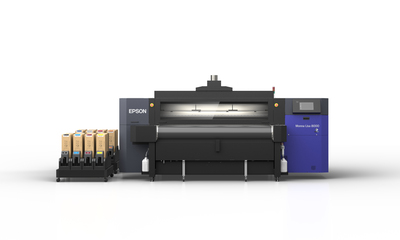
At the product‑development level, the Monna Lisa platform fundamentally reshapes the journey from concept to collection.
Traditional sampling demands rotary screens, minimum fabric runs and international shipping between mills, printers and design teams, baking weeks of delay and cost into each iteration. With Monna Lisa, designers can move from artwork approval to production‑quality strike‑offs on the intended fabric in hours.
Merchandising and buying teams gain confidence before committing to bulk, while brands cut waste and development expense. The same flexibility powers on‑demand production: instead of forecasting large inventory months ahead, labels can print closer to real‑time demand, enabling capsule drops, seasonal refreshes, school or team customisation and personalised products.
For companies reporting against ESG frameworks and tackling issues like water use, chemical discharge and obsolete inventory digital textile printing provides tangible, measurable improvements.
This pathway serves both ends of the market. Smaller brands can access premium local production without prohibitive setup costs, starting with short runs, iterating quickly and scaling as demand proves out. Larger companies can deploy smart‑factory cells within existing operations or partner sites, use data to right‑size runs, reduce markdowns and trace inputs end‑to‑end.
In each case, the outcomes align: conserving scarce water resources by replacing high‑impact dye and wash stages, cutting waste across sampling, production and inventory, reshoring targeted value chains that create skilled jobs and shorten delivery times, and increasing transparency for consumers, regulators and export markets.
The next 12 to 24 months are pivotal. As the AFC and Epson smart factory feasibility study concludes and early facilities come online, Australia has an opportunity to show a practical template for premium, technology‑enabled, low‑impact fashion manufacturing. The essential pieces are already here: mature digital print platforms, functioning on‑demand exemplars, community‑embedded social enterprises and a national strategy designed for scale with integrity.
Epson’s bet is simple and bold: give designers and manufacturers the tools to print what’s needed, when it’s needed, where it’s needed. The result is less water, less waste and more value staying onshore.
That’s not just a tech story or a fashion story or a manufacturing story, it’s a blueprint for rebuilding an industry to live within planetary limits while creating meaningful local jobs.
From Vision to Impact: How Epson is turning environmental ambition into measurable action
As the global sustainability agenda accelerates, the challenge facing multinational organisations...
Rittal RiLineX — A standardised 60 mm busbar platform engineered for AS/NZS 61439 switchboards
It is designed to flex with real world requirements while staying consistent enough to repeat...
The sustainability opportunity in HVAC&R is bigger than products: it's performance, people and follow-through
The biggest conversations aren't about whether emerging innovations exist, they're about...