Engineers extract lithium using low-water alternative
Engineers have developed a new technology that enables the direct extraction of lithium from solid salt mixtures derived from brines, providing a low-water, low-energy alternative to conventional lithium extraction methods.
Lithium recovered from salt-lake brines represents a major component of global supply, but extraction processes typically have low recovery efficiencies, long processing times and high freshwater demand.
The Monash team — Professor Huanting Wang, Dr Zhikao Li and PhD candidate Pan Liu, from the Department of Chemical and Biological Engineering — developed a different strategy that avoids extracting lithium directly from brines.
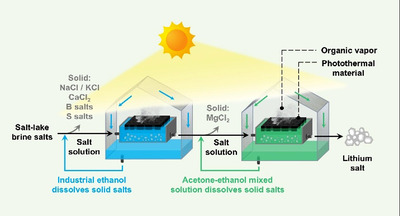
Instead, lithium salts are first isolated within solid salt mixtures derived from brines by selective dissolution using common industrial organic solvents such as ethanol and acetone.
By leveraging differences in solubility between lithium salts and coexisting salts, the process enables efficient separation without the need for freshwater inputs.
Published in Environmental Science & Technology, the technology demonstrated lithium recovery of around 95%.
The technology also overcomes one of the industry’s longstanding challenges by effectively removing boron and sulfate impurities, enabling the production of high-purity lithium.
To further improve sustainability, researchers integrated the process with interfacial solar evaporation, building on a concept developed by the Monash team more than a decade ago, allowing more than 99% of the solvent to be recovered and recycled using only sunlight.
Their approach has led to a patent application of the associated technology.
“This work shows that lithium can be efficiently separated from complex salt mixtures using simple organic solvents, without relying on freshwater or highly chemical-intensive processes,” Li said.
Li said the combination of selective dissolution and solar-driven evaporation offers a scalable pathway for more sustainable lithium production.
“By coupling these processes, we achieve high recovery rates and very high solvent reuse, which significantly reduces environmental impact while maintaining strong performance,” Li said.
Daikin DeVap evaporator range
Daikin Australia has introduced its DeVap evaporator range, designed specifically for Australian...
igus E2.1 range with igumid CG LW
The igus E2.1 energy chain series is switching to the recycled material known as igumid CG LW,...
Vertiv CoolLoop Trim Cooler
The Vertiv CoolLoop Trim Cooler is designed to operate with fluctuating water temperatures...