Co-digesting textile and food waste could create renewable methane
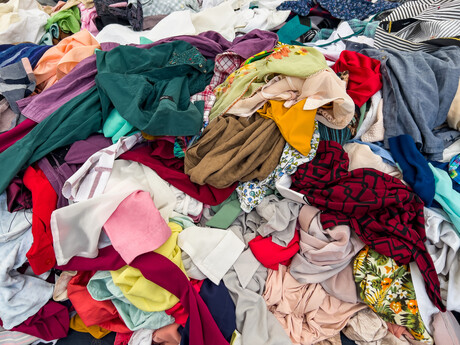
Researchers at the University of Auckland in New Zealand and James Cook University in Australia have found that anaerobic co-digestion of textile waste with food waste (FW) could turn these waste streams into renewable methane while reducing landfill and incineration.
The study examined mono- and co-digestion of cotton, polycotton, and wool with FW under mesophilic conditions. It tracked methane yield, biodegradability, process stability and synergistic effects. This matters because textile waste is difficult to digest alone, while FW is readily biodegradable and nutrient-rich.
The results show that lower S/I ratios and higher FW shares generally improved methane production, but performance depended strongly on textile type, carbon-to-nitrogen (C/N) balance, and the co-digestion performance index (C1).
Textile waste is generated at enormous scale, with about 92 million tonnes disposed of annually, yet landfilling, incineration and recycling remain costly or environmentally problematic.
Anaerobic digestion (AD) can convert organic-rich waste into biogas, but mono-digestion of textiles is limited by imbalanced C/N ratios, recalcitrant keratin in wool, and non-biodegradable polyester in blended fabrics. These materials can slow hydrolysis, cause acidification or ammonia inhibition, and reduce methane output.
Food waste (FW) is highly biodegradable and nutrient-rich, making it a promising co-substrate. Given these challenges, in-depth research is needed on how textile composition, S/I ratios and FW blending ratios govern methane production and process stability.
Researchers evaluated mono- and co-digestion of cotton, polycotton and wool with FW in mesophilic batch reactors. The study tested S/I ratios of 0.5 and 1 and different textile-to-FW and textile-to-textile blends. It combined methane measurements, kinetic modelling with a modified Gompertz model, and chemical and physical analyses of digestate. The team also calculated C1 values to identify synergistic or antagonistic co-digestion effects.
Methane yields increased as S/I decreased. Among textiles, cotton performed best in mono-digestion, producing 103 mL/g volatile solids (VS) and reaching 25.87% biodegradability at an S/I ratio of 0.5.
Co-digestion with FW generally raised methane production, and the highest yield, 129.7 mL/g VS, came from a cotton-to-wool ratio of 6:1, which had a balanced C/N ratio of 20.63. Synergy was strongest when FW made up more than 80% of the blend, especially with cotton, where C1 exceeded 1.
Kinetic analysis showed that more FW shortened lag phases and accelerated biogas production; the modified Gompertz model fit the data well. For example, a 1:4 cotton-to-FW blend reached 111 mL/g VS and about 29% methane content, while a 1:1 wool-to-FW blend produced almost no methane because of ammonia inhibition.
In contrast, polycotton and wool showed antagonistic effects (C1 < 1). Polyester, or polyethylene terephthalate (PET), resisted degradation, while wool’s keratin structure limited microbial access. Post-digestion analyses linked poor performance to residual volatile fatty acids (VFAs), soluble chemical oxygen demand (sCOD), and free ammonia nitrogen (FAN) above inhibitory thresholds.
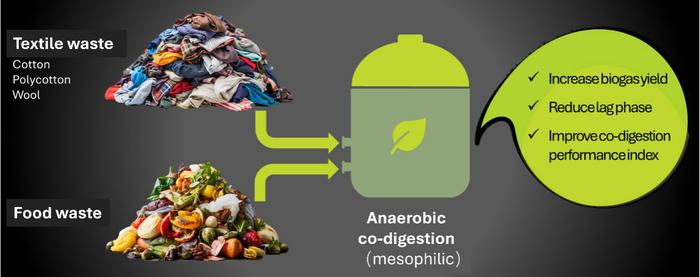
The authors said the findings provide a clear operating principle: co-digestion is most effective when FW dominates the blend and the C/N ratio stays within the optimal window. They said cotton-rich mixtures were especially promising, while polycotton and wool need pretreatment or fibre separation because polyester and keratin resist microbial breakdown.
They added that kinetic modelling helped explain why FW shortens lag phases and speeds up biogas production, and that C1 provides a simple way to screen promising feedstock combinations before scaling up.
For textile manufacturers, waste managers and biogas operators, the study suggests that co-digesting textile waste with FW can improve methane yields, stabilise digesters and divert waste from landfill.
The best results came from optimising S/I ratio and C/N balance, particularly when FW exceeded 80% of the feedstock. Pretreatment strategies such as thermal hydrolysis for cotton and wool, and environmentally friendly solvents to separate polyester from blended fabrics, could further improve digestibility.
Digestate quality also matters: most co-digestion treatments produced FAN within safe biofertiliser limits, although polycotton and wool blends exceeded inhibitory thresholds for AD.
The study was accepted on 3 July 2026 and published in Waste Disposal & Sustainable Energy.
Daikin DeVap evaporator range
Daikin Australia has introduced its DeVap evaporator range, designed specifically for Australian...
igus E2.1 range with igumid CG LW
The igus E2.1 energy chain series is switching to the recycled material known as igumid CG LW,...
Vertiv CoolLoop Trim Cooler
The Vertiv CoolLoop Trim Cooler is designed to operate with fluctuating water temperatures...