Organics processing facility opens in Hamilton
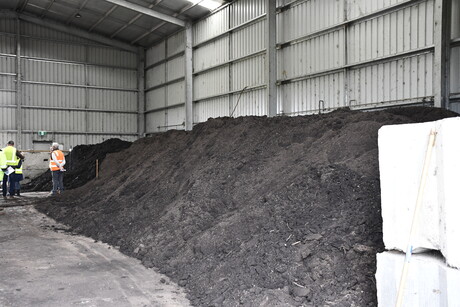
A new organics processing facility in Hamilton is set to keep thousands of tonnes of organic material circulating in the local economy — converting waste into a product with commercial and environmental value. The model is a shift for the local council from disposal to recovery.
Southern Grampians Shire Council’s new facility is designed to process more than 5000* tonnes of organic material a year when it opens, with potential to expand to 15,000 tonnes. It also has the potential to become a regional processing hub, creating new possibilities for how organic waste is managed well beyond the Shire boundary.
For Southern Grampians Shire Council Manager Waste and Sustainability Juan Donis, the facility represents a fundamental shift in how local government should think about waste.
“We can encourage people to recycle and educate them about reuse,” he said. “But we can’t force changes in behaviour. We need to change the system. We need to move towards a true circular economy, and we need to move soon.”
Mandatory FOGO collections, rolled out in the Southern Grampians in 2020, have significantly increased the volume of organic material councils manage each year. Until now, organic waste from the area was transported more than 100 km to an organics processor in Camperdown, Victoria to process with gate fees.
“We have thousands of homes filling their green bins every fortnight, intensified by weekly collections during springtime,” Donis said. “On top of this, our transfer stations accept thousands of tonnes of green waste from residents, the local agricultural industry, hobby farms and even Council’s own parks and gardens.
“It’s an enormous amount of material and processing costs go up every year. We had to stop looking at organic waste as something we pay to get rid of. We started asking what it was actually worth.”
When the Hamilton Organics Processing Facility opens in late 2026, it will initially process more than 5000 tonnes of material every year, with EPA approval allowing future expansion to 15,000 tonnes. Inside the facility, carefully controlled composting processes will accelerate natural decomposition, producing certified compost and soil conditioners suitable for agricultural use.
“We have councils driving through our shire to reach existing processing facilities,” Donis said. “We believe we can become a regional solution — take their waste, save them the trip, and then we sell the by-product once the facility has finished processing it.
“We will even be able to process materials like seaweed, which presents challenges for coastal councils. That’s the exciting part of circular economy thinking, you’re free to start solving regional problems instead of managing our local ones.”
Southern Grampians Shire Council Mayor Cr Dennis Heslin believes the new facility demonstrates that regional councils can lead innovation rather than simply respond to the many changing regulations that often dominate council work.
“Regional councils are often told that innovation happens in the cities,” Heslin said. “Well, I think projects like this prove exactly the opposite. We’re taking something we’ve always treated as a cost and turning it into an economic opportunity.
“We’re reducing transport costs, creating products with commercial appeal, and building an asset with the potential to generate long-term returns for both council and the wider community. Our stakeholders are our ratepayers, so we need to be mindful about how we spend their money and this facility lets us make better use of resources we already have.
“We’re an agricultural region. We’ve seen in recent years, with drought and bushfires, that if our agricultural sector suffers, we all do. Every tonne we process locally is an opportunity to support local industry and build a more resilient regional economy.”
Every tonne of compost produced represents nutrients returning to local soils, new opportunities for local industry, and the potential to attract neighbouring councils seeking alternative processing options.
“Twenty years ago, councils measured success by collecting waste efficiently,” Donis said. “Today we’re beginning to measure success by how little actually becomes waste.”
Southern Grampians Shire Council will host a Business Breakfast and facility tour ahead of the official opening of the new Organics Waste Facility at the Hamilton Transfer Station.
The event, to be held on Thursday, 17 September at the Speckled Frog in Hamilton, will give attendees the opportunity to hear directly from council and organics technology partner Gaia Envirotech about the processing system soon to begin operating at the Hamilton Transfer Station, followed by a tour of the facility.
Business Breakfast and Organics Waste Facility Tour
Date: Thursday, 17 September 2026
Time: 7:30–9:00 am
Location: Speckled Frog, Hamilton
Bookings are essential. Register your interest to attend here.
*Combined with approximately 2500 tonnes of household FOGO collected annually, Hamilton Regional Livestock Exchange (HRLX) will provide another 2500 tonnes of organic material that can be transformed into a commercially valuable product rather than buried in landfill.
Smart bin receives 2026 Australian Good Design Award
Rather than functioning as a conventional waste bin, it works as an IoT-enabled return point...
AI solar smart bins to end Vic fixed-route rubbish runs
Installation of the smart bins will be completed by the end of November, with 500 bins to be...
Qld Govt backs new resource recovery event
The event is gaining momentum among leading industry associations committed to advancing resource...