University and Unitywater foster future engineers and scientists
Unitywater and the University of the Sunshine Coast (USC) today signed an agreement to work together to benefit USC’s students by supporting their tertiary education and providing local opportunities to kickstart their careers.
“The agreement reflects the mutual work between the university, which educates engineers and scientists of the future, and Unitywater, which requires their talent to continue providing quality water supply and sewerage services to this growing region,” said George Theo, CEO of Unitywater.
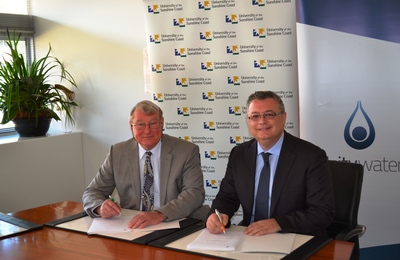
Programs outlined by the agreement include: a new Unitywater Scholarship in Engineering; paid vacation work for students at Unitywater; an entry pathway into Unitywater’s Graduate Program; and the opportunity to work together to identify innovative science and engineering research projects that aim to improve efficiency and environmental sustainability of Unitywater’s operations.
USC Vice-Chancellor Professor Greg Hill said the partnership would lead to some great teaching, research and engagement projects.
“We’ve also committed to exploring other opportunities to include new disciplines and mutually beneficial educational programs to promote and support both organisations,” he said.
The first Unitywater Scholarship in Engineering will be presented on 22 August as part of the university’s Engineering Awards. The scholarship provides $5000 per year to a Bachelor of Civil Engineering student majoring in Environment and Water in their third and fourth years of study.
“Each of the programs we are undertaking with the university provides these students with a great head start to their careers through relevant industry experience in which they can apply their knowledge and skills,” Theo said.
He predicts a background in environmental studies will provide students with key foresight when it comes to planning for the future.
“Increasingly, our operations involve more than engineered pumps and pipes. Our sewage treatment plants often incorporate wetlands that provide the final cleansing of treated water before it’s released into the environment,” he noted.
“These wetlands have environmental values that are important to the community, providing biodiversity and habitat for native species. We hope research students find they are rich grounds for study.”
UNSW HTH achieves highest sustainability rating
The 35,600-square-metre facility was developed to accelerate the translation of research and...
Fremantle Seaweed acquires onshore seaweed technology
The seaweed producer hopes to accelerate a path to commercial production by adding onshore...
Boral launches detailed carbon reporting capability
The company said the automated reporting capability eliminates the need to manually compile...