Refinery transforms CO2 into useable raw materials
Tuesday, 23 June, 2026
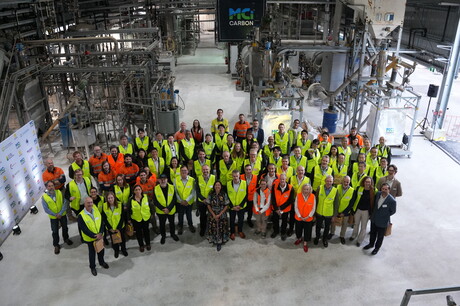
MCi Carbon has officially opened Myrtle, a fully integrated multi-purpose carbon refinery, marking a milestone for global industrial decarbonisation.
The mineral carbonation facility transforms CO2 and low-value mineral feedstocks into carbon-embodied materials used in everyday products. These include concrete, plasterboard, paint, paper, glass and adhesives — permanently locking carbon into raw materials.
Mineral carbonation is a low-pressure, low-energy chemical process. When industrial CO2 reacts with mineral-rich feedstocks — including steel slag and waste rock — it forms stable carbonates: chemically permanent mineral compounds with no leakage risk and no monitoring liability. The CO2 is locked into those materials at the molecular level and the process is zero waste.
The company said the technology has the potential to reduce net emissions in hard-to-abate industry by up to 90%. Unlike conventional decarbonisation approaches, the company generates saleable products in the process, reframing industrial decarbonisation as an investment with a return, rather than a cost.
The market for carbon-embedded construction materials is projected to reach US$1 trillion per year by 2050. With Myrtle now open on Kooragang Island in Newcastle, global industrial companies can rapidly validate MCi’s platform against their own feedstock, emissions profile and commercial requirements — and generate the commercial data needed to make profitable decarbonisation an investment decision, not a compliance cost.
Marcus Dawe, founder and CEO of MCi Carbon, said, “Heavy industry now has a commercial pathway to decarbonise — and profit while doing so. By transforming CO2 and low-value mineral feedstocks into carbon-embodied materials that cement, steel, plastics, glass and construction industries already buy, MCi Carbon’s mineral carbonation platform reframes decarbonisation as an investment with a return, not a cost to be managed.
“Myrtle is open. Our invitation to the leaders of hard-to-abate industry is simple: send us your CO2 profile and your feedstocks. We’ll run a rapid validation and hand back the technical, product and commercial data you need to make profitable decarbonisation your next capital decision, not your next compliance problem.”
Minister for Climate Change and Energy Chris Bowen officially opened the carbon refinery and said the project showed how regions like the Hunter can be at the centre of Australia’s clean industrial future.
“We’re backing Australian innovation to cut emissions and create the next generation of clean industries,” Bowen said. “This demonstration plant is a glimpse of what could become a major new industry for places like Newcastle and the Hunter. Taking carbon dioxide from industrial production and turning it into materials for homes, buildings and manufacturing is exactly the kind of practical, Australian-made technology we should be backing. This is about cutting emissions, creating new products and building new clean industries, literally brick by brick.”
At peak operation, Myrtle will support up to 50 highly skilled local jobs — including engineers and operators, many transitioning from fossil fuel and heavy industry roles. Scaled globally, MCi’s platform has the potential to create new industries and new skilled employment across the cement, steel and chemicals sectors as they transition to the low-carbon economy.
Sophia Hamblin Wang, co-founder and COO of MCi Carbon, said, “Myrtle embodies everything we’ve been building towards. We’ve spent more than a decade proving that carbon dioxide doesn’t have to be a problem, it can be a building block. Now we have an industrial-scale facility that can transform CO2 from industry into materials the economy already needs and buys.
“This isn’t a climate technology that needs a carbon price to work. The business model stands on its own. The way is open for industrial companies eager to stop paying to manage their emissions and start generating value from them.”
For more information, visit the MCi Carbon website.
Boral launches detailed carbon reporting capability
The company said the automated reporting capability eliminates the need to manually compile...
Epson MD serves meals for CEO CookOff
The OzHarvest CEO CookOff will bring together business leaders, chefs and corporate teams to...
World record set for large-scale perovskite PV efficiency
UNSW has collaborated with a high-tech energy company to set a benchmark for 676 cm2...