Partnership creates national manufacturing roadmap
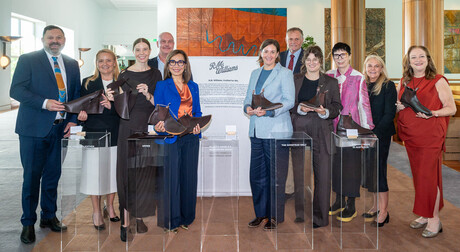
The Australian Fashion Council (AFC) and R.M.Williams have launched the National Manufacturing Strategy for Australian Fashion and Textiles 2026–2036 at Parliament House in Canberra.
The National Manufacturing Strategy is the first coordinated national roadmap to rebuild targeted domestic manufacturing capability across Australia’s textile, clothing and footwear (TCF) sector.
It was unveiled at a breakfast symposium and AFC member showcase in Mural Hall attended by over 90 industry and parliamentary guests, including members of the Parliamentary Friends of Australian Fashion & Textiles, and its co-chairs, Matt Burnell MP, Dai Le MP and Zoe McKenzie MP.
As the official print and projection partner of the Australian Fashion Council, Epson said it fully supports the Strategy, its outcomes and pillars that firmly promote Australia’s onshore manufacturing capabilities.
“Epson is firmly committed to our partnership with the Australian Fashion Council and our joint goals around improving local manufacturing, furthering innovation and developing digital transformation,” said Craig Heckenberg, Managing Director, Epson Australia.
“This National Manufacturing Strategy represents an important step forward for Australia’s fashion and textile industry. Epson is proud to support this initiative and help accelerate the adoption of advanced digital technologies that can drive greater sustainability, unlock new opportunities and create the jobs of the future.”
The 10-year Strategy is the result of almost a year of industry consultation led by the AFC and R.M.Williams, including 14 national consultations with manufacturers, brands, educators and policymakers across the country. More than 300 stakeholders contributed to the process, generating over 1000 proposed initiatives and nearly 900 votes on strategic priorities to shape the sector’s long-term manufacturing future.
Rather than compete against high-volume offshore manufacturing markets, the Strategy is focused on closing structural gaps and accelerating advanced manufacturing to scale the sector’s comparative advantage, aiming to position Australia to compete globally in premium, technology-enabled and traceable production, built on the country’s natural fibre strengths.
| Outcome Comparative Advantage | Comparative Advantage |
| 1. Capture more value from Australian fibre | Australia is a leading producer of premium natural fibres, including wool and cotton. Expanding domestic processing and spinning enables more of that value to be captured onshore. |
| 2. Strengthen sovereign manufacturing capability | Australia has capability in specialised textile products where quality, compliance and supply security matter, including defence, healthcare and emergency service applications. |
| 3. Build a globally competitive premium sector | Australia’s strength lies in high-quality, traceable and sustainably produced textiles and apparel, supported by natural fibres, strong design capability and advanced manufacturing. |
The Strategy outlines three strategic pillars underpinned by industry and government coordination as the levers required to deliver these outcomes by 2036.
| Strategic Pillar | Focus |
| 1. Activate and drive demand | Demand is the critical enabler. Strategic public procurement (federal and state) can anchor it, while Australian-made identification and coordinated national promotion can extend it through to consumer sectors. |
| 2. Secure the workforce of the future | Create new skilled pathways for advanced manufacturing roles, enable skills transfer (median age of manufacturer is 57), protect women’s contribution and participation (58% of TCF manufacturers are women) and support the diverse communities in the sector (41% are from CALD communities). |
| 3. Accelerate advanced manufacturing | Co-invest in modern machinery, new technologies and advanced manufacturing, rebuild early-stage fibre processing and yarn spinning — the sector's ‘missing middle’ — and enable innovation in circular manufacturing and fibre-to-fibre recycling. |
An economic case for action
Independent modelling by RMIT University found that full implementation of the Strategy’s coordinated policy platform will grow TCF manufacturing value added from $2.6 to $2.9 billion by 2030/31, delivering a cumulative $1.4 billion economic dividend over five years. The Strategy is also projected to create more than 1000 new skilled jobs and $864 million in additional wages, with approximately half of those jobs projected to be filled by women.
The Strategy’s launch at Parliament House marked an important moment for Australia’s fashion and textile industry. To showcase the capability already operating in Australia, AFC members from across the manufacturing sector presented a cross-section of domestic production. The showcase featured R.M.Williams, Bianca Spender, Bond-Eye Australia, Clothing the Gaps, ABMT, Sylvia P, Waverley Mills, Silver Fleece and Stewart & Heaton.
The AFC and R.M.Williams also produced a short film titled ‘Made Here, Worn Everywhere’ profiling AFC members including Australian Defence Apparel, The Social Outfit, Maara Collective, Citizen Wolf, Waverley Mills and Silver Fleece, highlighting the diversity of manufacturing already taking place across Australia.
You can watch the short film ‘Made Here, Worn Everywhere’ below.
What’s next: foundation to 2029
The Strategy will be led by the Australian Fashion Council as the peak body for the sector. Progress will be measured through a two-stage assessment framework.
- Implementation review (to 2029): This phase will assess progress in establishing the core architecture underpinning the Strategy, including procurement reform, national capability mapping, skills recognition pilots, shared manufacturing infrastructure and governance arrangements to coordinate delivery.
- Strategic outcomes review (to 2036): This phase will assess progress against the Strategy’s long-term ambition — a competitive, technology-enabled and domestically anchored manufacturing sector with a sustainable workforce pipeline and globally recognised market position.
The National Manufacturing Strategy for Australian Fashion & Textiles is supported by the Parliamentary Friends of Australian Fashion & Textiles group, co-chaired by Matt Burnell MP, Dai Le MP and Zoe McKenzie MP, with more than 60 bipartisan members across Parliament.
The Strategy can be viewed on the AFC website.
Study assesses recycled content use in home builds
Using a completed dwelling, the study explored how the percentage of recycled content use can be...
Beyond compliance: why ESG in construction is becoming a people issue
The shift comes as the industry faces significant workforce pressures, with skilled labour...
Nature is the blueprint for better cities
Consideration of the natural environment can no longer be treated as an optional design feature...