Tokyo researchers produce better, safer battery
University of Tokyo researchers have found a way to improve the performance and safety of lithium-ion batteries. The research findings — published in Nature Energy — could lead to longer journeys in electric vehicles and to the creation of a new generation of home energy storage, both with improved fire safety.
“A battery’s voltage is limited by its electrolyte material,” Professor Atsuo Yamada said.
“The electrolyte solvent in lithium-ion batteries is the same now as it was when the batteries were commercialised in the early 1990s.
“We thought there was room for improvement, and we found it.
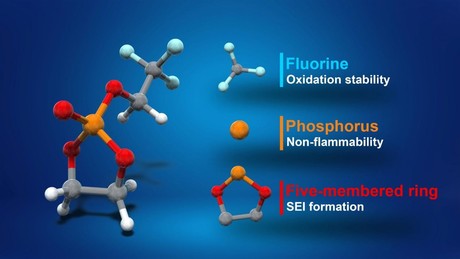
“Our new fluorinated cyclic phosphate solvent (TFEP) electrolyte greatly improves upon existing ethylene carbonate (EC), which is widely used in batteries today.”
EC is notoriously flammable and is unstable above 4.3 V. TFEP, on the other hand, is nonflammable and can tolerate voltages of up to 4.9 V. This extra voltage capacity means the batteries can last longer before they need another charge. As lithium-ion-powered electric vehicles proliferate, this extra range and safety would prove extremely useful.
“We’re proud of this development and its effectiveness came as a bit of a surprise,” Yamada said.
“This is because the way we came up with TFEP was novel in itself, thanks in part to our collaboration with organic chemist Professor Eiichi Nakamura.
“Most research on electrolytes is a bit trial and error, with slight alterations to the basic chemistry rarely offering any advantage. Our approach came from a theoretical understanding of the underlying molecular structures. We predicted the safe, high-voltage properties before we experimentally verified them. So it was a very pleasant surprise indeed.”
ACCC guidance on emissions claims to consumers released
The guidance aims to assist businesses in making accurate, credible emissions claims and to...
Industry transitions from gas to renewable heat: report
More than 230 Australian industrial sites and commercial buildings will have switched from gas to...
Industrial electricity costs could halve by sharing infrastructure
Heavy industry could reduce electricity costs by up to 50% by sharing renewable infrastructure...