Green hydrogen production receives boost using low-cost materials
RMIT researchers and international collaborators have found a way to increase green hydrogen production using low‑cost materials, providing a potential pathway to cheaper clean fuel.
By improving a widely used compound, titanium dioxide, the team reported hydrogen production more than 80 times higher than the commercial untreated version under the same test conditions.
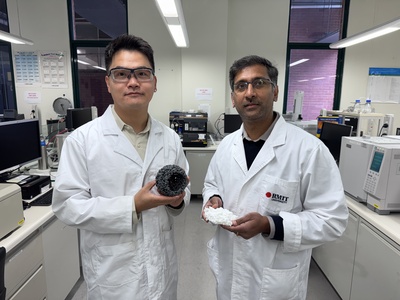
Lead researcher Dr Derek Hao, from RMIT’s School of Science, said the research added to a growing effort to make hydrogen production both more efficient and more affordable. Many of the most effective hydrogen-producing systems rely on expensive metals such as platinum.
“By showing how a common material can be improved to produce more hydrogen, the study points to a practical direction for future work,” he said. “If similar gains can be achieved under real-world conditions, it could help bring down the cost of clean hydrogen production at scale.”
RMIT collaborated with Zhoukou Normal University and Xinyang University from China on the research.
“This work shows that comparable performance can be achieved using low-cost, widely available materials, which is critical if hydrogen production is to scale up,” Hao said.
The researchers said one approach to hydrogen production uses light to split water into hydrogen and oxygen. However, in practice, much of that energy is lost before it can do useful work.
This research focuses on reducing that waste, helping more of the energy go into producing hydrogen rather than being lost along the process. Rather than developing an entirely new system, the team upgraded titanium dioxide, a material already used widely in coatings, pigments and energy technologies.
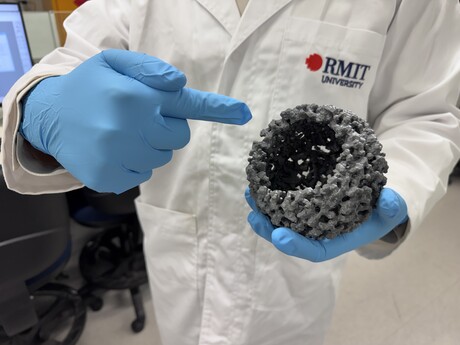
They made a series of small but targeted changes, including adding small amounts of nickel, introducing defects that help guide how energy moves and shaping the material into tiny hollow spheres to better capture light.
Together, these changes allow the system to hold onto energy longer and direct it to where hydrogen is formed.
In lab testing, the improved system produced significantly more hydrogen than standard versions, particularly when exposed to ultraviolet light. It also maintained performance over repeated testing, suggesting the approach is stable over time.
The experiments were carried out under controlled laboratory conditions using a methanol-containing solution, meaning the system demonstrates hydrogen production in a simplified setting rather than full water splitting. Performance was strongest under ultraviolet light, though the researchers observed some activity under visible light.
Further work is needed to test how the approach performs under full sunlight and without added chemicals.
The study is published in Applied Catalysis B: Environment and Energy.
Industry transitions from gas to renewable heat: report
More than 230 Australian industrial sites and commercial buildings will have switched from gas to...
Industrial electricity costs could halve by sharing infrastructure
Heavy industry could reduce electricity costs by up to 50% by sharing renewable infrastructure...
$3m investment in microgrids for Far West communities
The project will scope assets required to generate and store energy locally for NSW communities...