Floating wind turbine design could access cheaper energy
Ocean engineers at The University of Queensland have overhauled the design of floating wind turbines in a bid to secure easier access to cheaper energy from strong offshore winds.
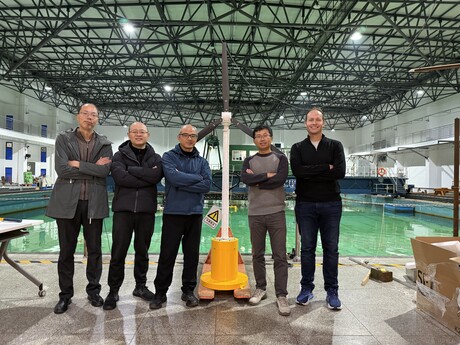
Associate Professor Wenhua Zhao has tested a scale model design that could support a 3.6-megawatt turbine consisting of an 87-metre tower and blades spanning a 120-metre diameter floating in 200 metres of water.
Zhao said governments and marine-based industries worldwide had shown interest in floating turbines because they can be assembled and deployed in harsh ocean regions with consistent, forceful winds, while overcoming the limit of water depth to unlock vast renewable energy potential.
But despite investment in the technology, Zhao said the uptake had been limited by the cost of engineering complex substructures and anchoring mechanisms.
“The issue is not about whether floating turbines work, or whether they offer benefits for shipbuilders, resources companies or aquaculture,” Zhao said. “The issue is the price. Floating turbines are currently about twice as expensive as turbines fixed in shallow waters, and almost four times the cost of land-based turbines.”
To address this hurdle Zhao and his colleagues at UQ’s School of Civil Engineering used geometry — based on the first principle of offshore hydrodynamics — to inform the creation of a scale model that can be built and installed at a 40% discount to similarly sized floating wind turbine structures. Zhao’s design also provides superior longevity with fewer maintenance requirements.
“Using conventional marine construction materials in a cost-conscious configuration allowed us to significantly reduce costs,” Zhao said. “We also used internal stabilisation features to lower its centre of gravity to make it more stable.
“These features mean it is possible to keep the wind tower vertical even under strong wind conditions, increasing the efficiency of power generation.”
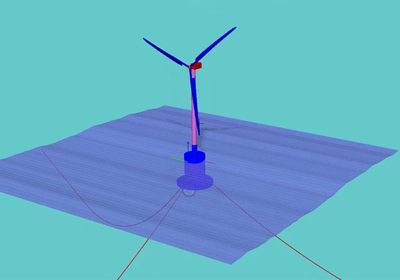
Using deep ocean and extreme weather simulations, Zhao confirmed his prototype can be scaled to support a full-sized tower similar to those on land.
Modelling also showed the design could survive a one-in-100-year storm and be moored in water up to 200 metres deep, where fixed offshore turbines had previously been limited to a depth of 50 to 60 metres.
Further testing undertaken in a wave basin facility at Shanghai Jiao Tong University in China provided further validation and increased confidence in the proposed design.
Zhao said the technology is expected to be ready for commercial adaption or implementations in the next two years. He said he is working with industry partners to explore how the turbine can be down-scaled to niche applications to offer offshore industries cheaper, flexible energy solutions.
“We see tremendous potential for this technology to be adopted across Australian offshore industries,” Zhao said. “It could provide clean, reliable power for offshore operations, the decommissioning of aging offshore platforms, emerging offshore aquaculture, and future deep-sea data centres.”
$3m investment in microgrids for Far West communities
The project will scope assets required to generate and store energy locally for NSW communities...
$11m to supply clean energy for social housing tenants
The pilot will install solar panels on social housing properties and connect them through a...
Offshore wind project to connect to Vic grid
The route will connect the first offshore wind project off the Gippsland coast to the state's...