UNSW researchers find secret to better solar cells

UNSW Sydney engineers have harnessed the fundamental skills of bakers to ensure next-generation environmentally friendly solar-cell materials form with fewer tiny defects.
The discovery allows the cells to convert sunlight into electricity more efficiently than before and could provide a blueprint for improving a wide range of advanced semiconductor materials.
The researchers said the trick is to imagine baking a cake. Although every ingredient is carefully measured and mixed together, sometimes as the cake bakes the butter can pool in one corner, the cinnamon is stronger in one section, and the fruit sinks to the bottom. So even though the ingredients were all correct and the recipe was followed, the final cake is far from perfect.
Something remarkably similar happens when manufacturing solar cell materials, the researchers said.
“The cake analogy is really apt because that’s exactly what we are doing,” said Scientia Professor Xiaojing Hao from UNSW’s School of Photovoltaic and Renewable Energy Engineering.
“With a cake you mix all the different ingredients and put it into the oven. We do a similar thing with solar cell material, except it goes into a furnace,” Hao said.
In the research, published in Nature Energy, the researchers have shown that it isn’t simply the ingredients that matter — it is keeping them evenly distributed throughout the earliest stages of manufacturing.
By preventing those ingredients from drifting apart, the team reduced tiny defects inside the material that limit how efficiently it converts sunlight into electricity.
The findings establish a new design principle that could not only improve this particular solar technology, but also influence the development of many other advanced semiconductor materials.
Looking beyond silicon
Most solar panels are made from silicon, a technology that has become efficient over decades of development. But researchers are already searching for ways to push solar performance even further.
One of the most promising approaches is the tandem solar cell, which combines two different semiconductor materials so each captures different parts of the solar spectrum.
Hao’s team, including Dr Ao Wang and Dr Kaiwen Sun, is studying a material known as CZTS made from copper, zinc, tin and sulfur.
Unlike some competing semiconductor materials, its ingredients are abundant and comparatively environmentally friendly, making it an attractive candidate for future tandem solar cells.
The challenge has been that, despite its promise, CZTS has stubbornly resisted attempts to reach the efficiencies needed for commercial adoption.
The culprit is tiny defects that form as the material is manufactured.
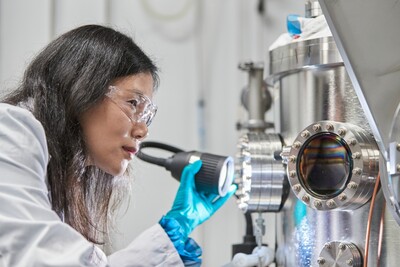
Hao said many researchers have traditionally focused on ensuring they started with the correct combination of ingredients.
“A lot of people think once you have the right amount of ingredients for the cake, then everything will be fine,” she said. “But sometimes that’s not the case. You need to keep the ingredients uniformly distributed from the very beginning and throughout the cooking process.
“The journey matters just as much as the destination. That’s the major design principle we’ve implemented in this research to discover why CZTS can have the imperfections.”
Rather than concentrating on whether the ingredients of the solar cell material were wrong and needed to be amended, the team investigated what happens during the first moments of the high-temperature manufacturing process.
They discovered that one element in particular, the copper, was prone to moving away from where it was needed. That seemingly small change triggered the formation of unwanted impurities and tiny structural defects that prevented the material from performing at its best.
The UNSW team then found that strengthening the copper–sulphur bonding during the initial thermal reaction significantly reduced defect formation and enabled the material to achieve record voltage performance for this class of CZTS solar cell.
Eliminating hidden flaws
Although the defects in CZTS are incredibly small, many no larger than individual atoms, their impact on solar-cell performance is enormous.
“When one ingredient drifts away, it forms another phase, which is technically another material. So when the crystal grows, you end up with impurities and tiny imperfections inside it,” Hao explained.
“It also causes disorder inside the crystal. Those point defects can trap the photo-generated carriers, and that causes the low efficiency of solar cells.
“Voltage is a direct measure of the energy loss inside the solar cells. Every detrimental defect reduces the voltage. Defect control determines the final efficiency and how much energy can be converted from sunlight.”
Using their new manufacturing strategy, the team achieved a certified efficiency of 12.4%.
While that efficiency remains below commercial silicon solar cells, the researchers said the result is significant because it addresses one of the technology’s longest-standing scientific challenges.
A solution for other materials
The researchers believe the most important outcome is not simply a better CZTS solar cell.
Instead, they said the work establishes a broader design strategy that could help improve many different semiconductor materials used in future solar technologies.
Wang said researchers have often assumed that if the starting ingredients are correct, the heating process will naturally produce the desired material.
“Most people focus on getting the right recipe and think the thermal process is a black box. They assume that once the ingredients are mixed well then the cake, or in this case the solar cell, will naturally come out as intended,” he said.
“But this is not the case. If the butter starts separating in the first few minutes of baking, even a perfect recipe won’t produce a perfect cake.”
That simple idea could have implications well beyond CZTS. Many advanced semiconductor materials consist of several different chemical elements, making them susceptible to similar problems during manufacturing.
Hao believes understanding, and then controlling, how those ingredients behave during the earliest stages of fabrication could become an important design principle across the field.
“The defect control strategy we’ve developed is going to be really useful for designing and optimising other compound semiconductors,” she said.
“I hope our defect control technology and principle can really be used by other people who are designing more top-cell candidates for tandem solar cells.
“The design principle isn’t only about this material. It’s about not only looking at the final recipe; we need to design from when we’re mixing the ingredients and keep them uniformly distributed. The ingredients may change from one semiconductor to another, but the design principle is the same.”
IFS Zero agentic emissions operating system
The system provides a single, unified calculation platform that enables organisations to measure,...
ABB Battery Energy Storage Systems-as-a-Service
ABB has launched its new BESS-as-a-Service — a flexible, zero-CapEx solution...
Mitsubishi Electric FR-D800 series inverters
The FR-D800 series inverters are designed for a range of industrial applications.