Fiji resorts cut diesel dependency by 50% using solar
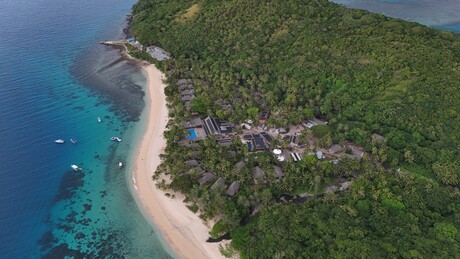
A complex off-grid solar and battery deployment in the Yasawa Islands provides proof that solar technology has the potential to solve remote energy challenges.
Three off-grid island resorts in Fiji’s Yasawa archipelago are projected to reduce their diesel costs by 50% in 2026 following the deployment of solar.
With 80% of Fiji’s regional energy supply reliant on imported petroleum products, the country could face a 115% increase on its annual fuel import bill from 2025 levels — equivalent to almost three times its healthcare budget. The Yasawa Island Resorts — Paradise Cove, Blue Lagoon and Octopus Resort — were previously 100% reliant on imported diesel for energy generation.
Auckland-based Future Energy NZ engaged SolaX Power Australia to deliver the solar battery energy storage system for the project. SolaX provided the AELIO battery energy storage systems, site inspection, commissioning, design review and operations and maintenance training.
The resorts have now transitioned to a 760 kW solar and 1.6 MWh battery system that is projected to deliver FJ$850,000 (AU$538,000) in annual fuel savings across the portfolio.
The project’s carbon impact is estimated to have avoided 464.68 tonnes of CO2 annually — the equivalent of planting 7600+ trees.1
Danny Fang, Senior Field Application Engineer at SolaX Power Australia, travelled to Fiji to oversee commissioning of the project, which was not without its challenges.
“The Yasawa Islands presented conditions that push energy systems to their limits. With no grid infrastructure, no local supply chain and exposure to coastal heat, tropical rain, humidity and salt air, every component had to be shipped by container and engineered for long-term reliability and durability.”
SolaX also delivered hands-on, end-to-end training to the local workforce who had no prior solar experience. These electricians now operate and maintain a full 1.6 MWh system.
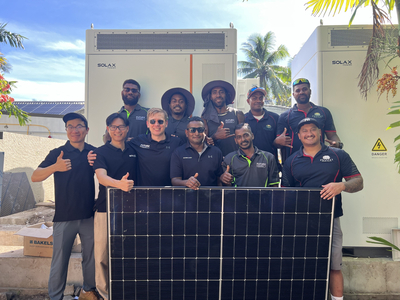
“Providing on-the-ground support means genuine local ownership and long-term technical capability for the project on the islands, reducing reliance on expensive external technical support,” Fang said.
Nick Wood, owner of Yasawa Island Resorts, said the project protected his business from global fuel price volatility and soaring diesel costs.
“If you look at the fuel we were using at Paradise Cove alone, and the 80% surge in diesel prices due to the conflict in the Middle East, the increase in our operating costs would have been massive. Solar takes that pressure off. Now, we’re at similar levels to what we were at before we energised the system.”
The economics are compelling even before Fiji’s tax incentives — which include a 100% capital expenditure write-off and duty-free importation for solar and battery investments until 31 December 2028.
Wood’s pre-tax payback across the full three-resort project is two to three years. And the diesel cost savings are stepping up as further batteries come online:
- 35% diesel cost saving achieved across the first six months of operation
- 50% diesel cost saving projected across the full year
- 70–75% diesel cost saving target by end of 2027, once further panels and battery capacity are added.
The transition to renewables is also improving resort operations and guest experience. Solar power now provides stable energy to desalination plants previously run on diesel generators, supporting the daily water needs of approximately 200 live-in staff and tens of thousands of guests annually across the three resorts.
Reduced load on diesel generators has also eliminated mid-service shutdowns that previously left guests dining in darkness.
Surplus solar generation is enabling a planned transition from gas hot water to heat pump systems across all three resorts, projected to save a further FJ$95,000–$110,000 (AU$87,000–$101,000) per year in gas costs.
“A remote Fijian island was a demanding environment: no grid, salt air and extreme heat. AELIO performed across all three resorts and the savings speak for themselves,” said Joey Zhang, General Manager of SolaX Power Australia.
“Our partnership with Future Energy shows what’s possible in remote, off-grid conditions. This solution is available to any operator across the Pacific — and Australia — still relying on expensive imported diesel.”
Alastair Mortensen, Director of Future Energy, said the project demonstrates a compelling case study for future remote and off-grid projects.
“If we can do it here, we can do it anywhere. Remote lodges, rural hospitals, data centres: the barriers to solar are lower than most businesses think. And right now, reducing reliance on diesel has real benefits, not just for the environment, but for their bottom line.”
1. Estimate is calculated based on Paradise Cove data from previous seven months.
Phone: 1300 476 529
IFS Zero agentic emissions operating system
The system provides a single, unified calculation platform that enables organisations to measure,...
ABB Battery Energy Storage Systems-as-a-Service
ABB has launched its new BESS-as-a-Service — a flexible, zero-CapEx solution...
Mitsubishi Electric FR-D800 series inverters
The FR-D800 series inverters are designed for a range of industrial applications.