Engineering sustainability from the ground up at Selfs Point STP
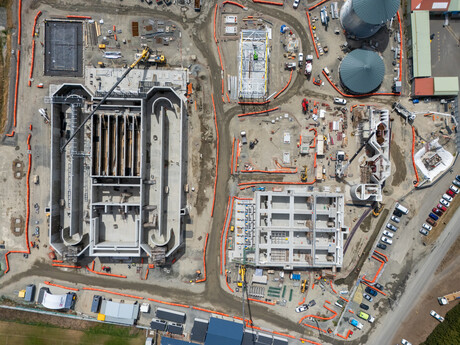
Project: Selfs Point Sewage Treatment Plant Upgrade, TasWater
Why did the ground matter?
Hobart’s sewer network is being reshaped for a growing city, with wastewater flows from Macquarie Point ultimately redirected to an expanded treatment plant at Selfs Point. The transformation also supports the wider redevelopment of Macquarie Point. But before new tanks and process structures could rise at Selfs Point, the project had to solve a less visible problem: the ground beneath them.
The site sits on former landfill and reclaimed land near New Town Rivulet and the Derwent River. Investigations identified around five to 10 metres of variable fill over soft, highly compressible alluvial soils. For large tanks, treatment structures and buried services, those conditions created a real risk of settlement and uneven movement over time.
Those conditions also brought an environmental consideration. Excavating landfill-affected or contaminated fill can create additional handling, haulage and disposal requirements. Where it could be done safely, limiting excavation and keeping material in place was therefore an important part of reducing disturbance while still achieving the long-term performance the new infrastructure required.
The foundation strategy therefore had to do more than simply support the weight of the new infrastructure. It needed to manage uncertainty in the ground, limit long-term settlement, and provide confidence that critical wastewater assets could perform reliably over a hundred-year period.
What are CMCs and why were they used?
In simple terms, controlled modulus columns, or CMCs, are rigid concrete inclusions installed through weak ground to improve the way loads are carried and distributed. At Selfs Point, the columns work together with an engineered load-transfer platform above them, creating a more stable foundation for the structures built on top.
The specialist contractor, Menard Oceania, installed the CMCs using a displacement-auger method. Rather than excavating a large hole for each column, the installation process pushes much of the surrounding ground sideways as the column is formed. On a former landfill site, this reduced direct interaction with contaminated material and provided low-spoil and low-vibration construction characteristics.
How much ground improvement was actually delivered?
At the completion of the CMC installation, as-built records verified a total of 5862 CMCs across the Selfs Point STP project, representing approximately 71,702 linear metres of installed columns and 10,884 cubic metres of concrete used.
The project’s established measurement and verification process reconciled final installation schedules, construction records and quantity data so the sustainability assessment could be based on completed works.
How do you measure sustainability through the CMC solution?
A key lesson from Selfs Point is that credible sustainability reporting depends as much on defining the limits of a claim as it does on identifying a benefit.
To support the project’s formal sustainability rating, as-built reporting and compliance requirements, the team developed a measurement & verification framework that separated design estimates from final outcomes and distinguished between benefits that could be quantified and those best reported qualitatively.
That distinction matters for sustainability ratings: a strong claim is one that can be traced back to reliable evidence, with clear boundaries around what the data can and cannot demonstrate.
Ground improvement was already part of the project’s agreed engineering baseline, so the principal quantified sustainability benefit was not simply the use of CMCs. It came from improving the concrete used to construct them beyond the agreed business-as-usual benchmark.
Portland cement is a major contributor to the embodied carbon of concrete. Supplementary cementitious materials, or SCMs, can replace a portion of that cement while still meeting the required performance specifications.
The agreed baseline for the CMC concrete assumed an average 10% SCM replacement. The approved mix delivered at Selfs Point achieved a 27% replacement through the use of fly ash.
Applying the lower-carbon CMC mix to the final as-built concrete quantity resulted in a project calculated embodied carbon benefit of 936 t CO2e. The displacement installation method also reduced spoil generation and the need to disturb contaminated material.
The role of digital assurance
With thousands of columns installed across the site, quality assurance also needed to operate at a similar scale. Instrumented installation rigs captured digital information as the CMCs were constructed, including key parameters relating to depth, drilling and concrete placement.
Complete telemetry records were retained across all CMC work areas, creating traceable installation that could be checked against design and construction requirements. This is an important sustainability outcome. These digital as-built records strengthen confidence in what was installed, reduce reliance on retrospective data gathering and help lower the risk of defects and rework.
The same data can support quality assurance, handover, sustainability reporting and future learning rather than being collected separately for each purpose.
Environmental assurance followed a similar real time approach. SiteHive monitoring was used during the works to provide live noise data and alerts when thresholds were exceeded. Directional noise mapping also helped the project team investigate where a noise event was coming from, including whether the source was associated with project activities or other local noises.
These digital records supported and complemented the project’s engineering inspections, testing and acceptance processes.
What can future projects take from Selfs Point?
The lessons are relevant well beyond wastewater infrastructure. Projects involving weak, variable, reclaimed or contaminated ground often face the same challenge: achieving reliable long-term performance while managing construction impacts, materials, risk and uncertainty.
- Involve specialist expertise early — Projects on weak, reclaimed, landfill or contaminated ground can benefit from bringing geotechnical designers and specialist ground improvement contractors into the conversation early.
- Build evidence requirements into delivery — Establishing requirements for as built schedules, material records, and digital telemetry before construction helps ensure the right information is captured throughout delivery. These records can then support quality assurance, handover, sustainability rating requirements and future project learning.
- Quantify what can be verified — Embodied-carbon reductions are most meaningful when they can be demonstrated against an approved baseline using verified final quantities. Where complete data is not available, a clear and well-supported qualitative assessment is preferable.
For infrastructure owners and delivery teams, the broader lesson is that sustainability and geotechnical engineering do not need to be separate conversations. At Selfs Point, a difficult ground condition led to a foundation strategy that combined specialist design, lower-carbon materials, digital assurance and evidence-based measurement.
The result is more than a solution for one site. It offers a practical model for how future projects can approach challenging ground conditions while keeping resilience, constructability, carbon, and verifiable sustainability performance in view from the beginning.
Floating wetland pods cut greenhouse gas emissions
An RMIT study found that CO2 emissions dropped by up to 36%, methane by up to 66% and...
A matter of influence: getting over the 'ick' with recycled water
New research shows how social media influencers could help to overcome the resistance to...
Researchers trial magnetic resin to remove PFAS
A magnetic resin invented at The University of Queensland will be trialled at wastewater...