Upcycled mattresses to become sustainable insulation
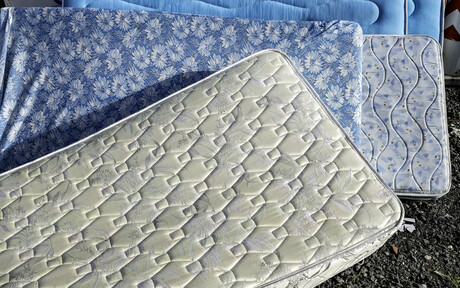
Swinburne researchers have turned old, unwanted mattresses into safe and sustainable building insulation materials using fungi.
With their findings published in Nature’s Scientific Reports journal, the team grew a common fungus together with shredded mattress foam to create a new material that is solid and lightweight.
Mattresses are one of the hardest household items to recycle, explained Swinburne authors Dr The Hong Phong (Peter) Nguyen, Associate Professor Mostafa Nikzad and Dr Huseyin Sumer.
“Mattresses are durable, bulky, and often end up in landfill,” Nguyen said. “Through natural biological processes, we can give this waste a second life.”
The process involves fungal roots binding to the waste, forming natural mineral compounds that can resist extreme heat, remaining stable even when exposed to temperatures close to 1000°C.
“The material performed well as an insulator, with heat-blocking ability very close to commercial insulation products already used in homes and buildings,” Nguyen said.
“The approach is both practical and environmentally responsible, using fungus that is closely related to strains used in food production and medicine, and relying on common, widely used chemicals.”
1.8 million mattresses are disposed of each year in Australia, according to Director of Innovation at the Australian Bedding Stewardship Council, Tracey Pryor, who co-funded this research.
“740,000 mattresses are still sent to landfill, equating to approximately 22,000 tonnes of needless waste that can take up to 120 years each to decompose,” Pryor said.
Nguyen hopes that with further development, this fungus-based material could also be used as fire-resistant insulation, building panels, or even be shaped for future construction methods such as 3D-printed building elements.
“Our work shows how combining biology with waste materials, while leveraging deep manufacturing science, can lead to smart, low-impact solutions that better the environment and the lives of everyone,” Nguyen said.
Organics processing facility open in Hamilton
The facility is set to keep thousands of tonnes of organic material circulating in the local...
Container Exchange appoints new CEO
COEX said the appointment provides continuity and stability for the organisation to deliver...
Researchers create compact supercapacitor designed for reuse
The research team said these findings demonstrate a promising approach for lightweight energy...