Researchers recover silver from end-of-life solar panels
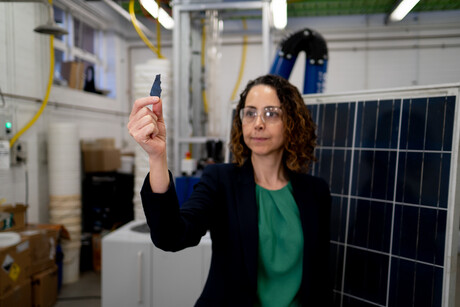
University of Newcastle researchers are taking a step towards making solar panel recycling economically sustainable.
The team has successfully scaled up a process that recovers valuable silver from end-of-life solar panels, demonstrating almost 100% silver recovery during the continuous pilot-scale flotation trial for solar panel recycling.
Researchers recovered silver from almost half a tonne of retired solar panels, building on the team’s earlier research showing that froth flotation — a mineral-processing technique widely used in the mining industry — could recover silver from solar waste without the need for acid.
Associate Professor Mahshid Firouzi, Deputy Director from the University of Newcastle’s Centre for Critical Minerals and Urban Mining (CRITIUM), said the challenge was no longer whether silver could be recovered from solar panels, but whether it could be recovered at a scale and cost that made recycling commercially viable.
“Our earlier small-scale batch research proved flotation could recover silver from solar panels,” Firouzi said. “This latest work demonstrates that the process can operate continuously at a much larger scale with nearly 100% silver recovery, bringing us closer to commercial implementation.”
The pilot processed 22 kg of solar-cell material recovered from approximately 460 kg of end-of-life solar panels, which is equivalent to around 23 residential solar panels. The researchers recovered almost 100% of the silver and concentrated it into a high-value product representing just 1.25% of the original material.
The resulting product contained more than 80 times the silver concentration of the original solar cell material.
The team’s preliminary economic assessment suggests the flotation-based process could be three to five times less expensive than conventional acid-leaching approaches. Recycling solar panels is currently estimated to cost around $10–15 per panel, compared with only a few dollars to send a panel to landfill.
“At the moment, recycling often costs more than landfill. But if recyclers can efficiently recover and sell the silver contained within solar panels, that changes the economics completely,” Firouzi said. “Silver is the highest-value material in a solar cell. Recovering it has the potential to make solar-panel recycling far more financially attractive.”
The University of Newcastle process uses water, air and small amounts of chemicals that help the silver attach to air bubbles, allowing it to be separated and recovered without acid.
“We’re applying proven mineral-processing technology to one of the fastest-growing waste streams in the renewable energy sector,” Firouzi said.
“If we’re serious about building a circular economy, we need to think not only about how we generate clean energy, but also how we recover the materials that make those technologies possible.”
The research team is continuing to investigate opportunities to apply the technology to other waste streams, including printed circuit boards from decommissioned data centre equipment and other electronic waste.
The findings have been released as a preprint in ChemRxiv.
Weekly FOGO service for Sutherland Shire
The FOGO rollout will commence with single-dwelling households, with future expansion planned for...
'Biodegradable' claims banned in Europe
Effective since 27 September 2026, environmental claims have been banned in the EU unless the...
50.6m tonnes of Australian waste recycled in 2024–25
National data has shown that government investment in recycling is delivering welcome progress,...