Researchers create compact supercapacitor designed for reuse
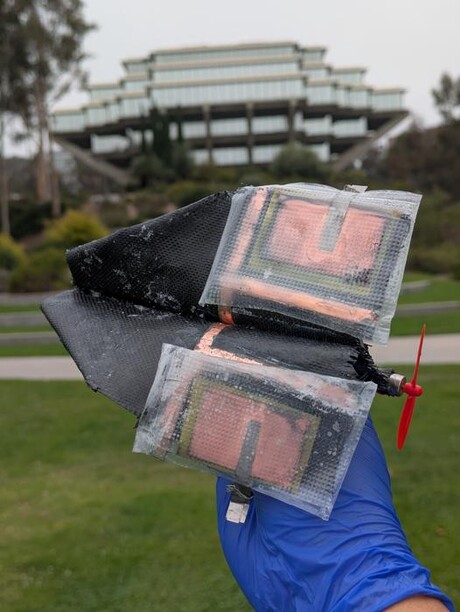
Researchers have developed a compact supercapacitor that can be quickly disassembled into reusable components.
The team used the devices to power a glider’s propeller and then took apart one supercapacitor and sequentially reused parts in two new ones that the researchers said performed as well as the original device.
Many rechargeable devices use lithium-ion technology and contain flammable electrolytes. Additionally, they are hard to recycle because the components don’t come apart easily.
So, Tse Nga Ng, Nandu Koripally and their colleagues searched for a more sustainable approach for compact energy storage. Their work led them to develop a supercapacitor that used zinc ions in a water-based, non-flammable electrolyte, dissolvable adhesives, and reusable electrically conductive materials.
“We built on our lab’s prior work, combining high-energy alternative zinc-ion chemistry and structural supercapacitors to make a recyclable version that enables second-life cells and outperforms prior state-of-the-art devices,” said Koripally, the lead author of the study.
For the supercapacitor, the researchers created a zinc metal-copper-foil anode and an activated-carbon-fibre cathode. In between, they placed a solid electrolyte made from a porous resin coated onto a plastic film and soaked in a zinc(II) chloride salt solution. The resin formed strong bonds when heated but broke apart in a slightly acidic liquid. Finally, they fused the layers together with heat, forming a thin device with a 2-volt potential.
As proof of concept, the researchers integrated four supercapacitors into the wings of a model glider. When tossed like a paper airplane, it went 12 feet (3.7 m) when the propeller’s motor was powered by the supercapacitors, compared to 8 feet (3.4 m) without an external power source.
The researchers then placed one of the supercapacitors in a mildly acidic, water-based solution to disassemble it. Within 30 minutes, the layers separated. The recovered carbon-fibre cathode was reused twice more, each time with fresh solid electrolytes and zinc anodes. From initial fabrication through two rounds of recycling, the carbon fibres successfully completed more than 172,000 charge–discharge cycles and maintained similar electrical performance throughout their lifetime.
The team said these findings demonstrate a promising approach for lightweight energy storage that minimises electronic waste.
“Sustainability and performance do not have to be competing goals,” Koripally said. “By considering the full material lifecycle, we can combine design requirements into one solution to make structural energy storage devices that maintain high performance and are simple to repair and reuse.”
The team’s research has been published in ACS Energy Letters.
Weekly FOGO service for Sutherland Shire
The FOGO rollout will commence with single-dwelling households, with future expansion planned for...
'Biodegradable' claims banned in Europe
Effective since 27 September 2026, environmental claims have been banned in the EU unless the...
50.6m tonnes of Australian waste recycled in 2024–25
National data has shown that government investment in recycling is delivering welcome progress,...