Epson celebrates a 50-year legacy with progress in sustainable innovation
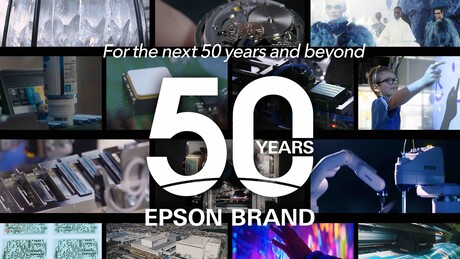
2025 sees Epson celebrate 50 years since the creation of the company’s brand. With origins in Japanese precision watchmaking, Epson has continually pushed the boundaries of efficient, compact and precise technology — while upholding its founding principles of integrity, effort, creativity and challenge.
Today, Epson is globally recognised for printers, projectors and other technologies that reflect its legacy of innovation and commitment to a more sustainable future.
At a group level, Epson has achieved significant decarbonisation milestones through its transition to 100% renewable electricity across all global sites, including manufacturing sites and all Australian and New Zealand offices. At its manufacturing sites, Epson also prioritises the use of locally generated renewable electricity wherever possible.
The company is also decarbonising their logistics through initiatives such as adopting alternative fuels and using maritime transport to further reduce their greenhouse gas emissions.
But where did it all start and how?
Well, Epson has had and achieved many notable milestones in the last 50 years.
In fact, the company was founded in 1942 and started life as Daiwa Kogyo. Epson at that time was a brand that was yet to be born.
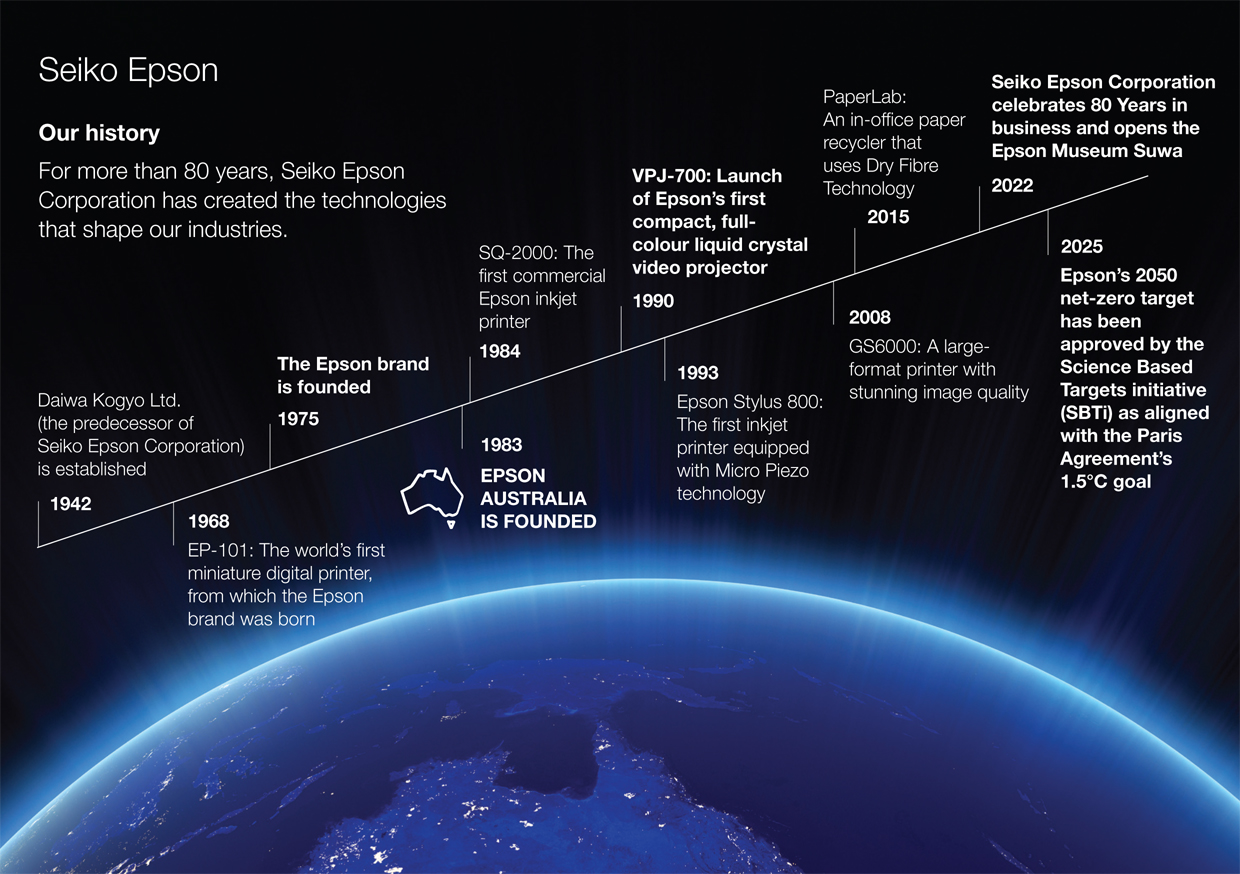
Daiwa Kogyo made the company’s first mechanical watch, developed and manufactured the first electronic recording systems for sporting events such as the Olympic Games and produced the revolutionary EP-101, the world’s first miniature digital printer.
The 1970s saw one of the company’s first real sustainability and environmental initiatives come into action as it began treating wastewater discharged from its manufacturing site to avoid polluting the beautiful and nearby Lake Suwa.
The company’s sustainability journey had now begun in earnest and in 1975 EP (from EP-101 fame) had a “son” and the Epson brand (literally the son of EP) came into being.
With its traditional energy and vigour Epson then developed the world’s first hand-held computer, the HX-20, in 1982, by bringing together Epson’s core technologies and the same year saw them produce world’s first television-equipped watch — a gadget seen and used by none other than James Bond himself in the movie, Moonraker.
The HX-20 led to the ET-10 (no relation to the cute little alien) but instead the world’s first commercial liquid crystal pocket colour television. This groundbreaking television was easily portable thanks to a conveniently small, thin shape that allowed it to be slipped into a pocket and taken anywhere.
Then 1984 saw a real breakthrough in printing as the company’s famous SQ-2000 was commercialised in Japan as Epson’s first inkjet printer. This development was to take the company forward to a number one market share in many printing categories across the world over the coming years.
In 1988, Epson became the world’s first company to announce that it would completely phase out the use of chlorofluorocarbons (CFCs) in its global operations. Thanks to an intensive Epson groupwide effort they became CFC-free in Japan in 1992 and worldwide the following year.
This was a groundbreaking step for Epson and one followed by companies across the globe.
In 1989, Epson developed the technology for the world’s first compact, full-colour liquid crystal video projector. Again and similar to its development of inkjet printer technology, this development in projection technology led to Epson becoming a market leader in projectors the world over in coming years.
In 1992, Epson was recognised by the US Environmental Protection Agency (EPA) for its efforts to eliminate CFCs from its operations. This recognition was one of many that were to be awarded to the company as its efforts in sustainable and environmentally friendly and responsible business practices progressed.
Monsieur, an ultraminiature (think the size of a 20-cent coin), self-propelled mobile robot was developed in March 1993 and was a product born of the watch-related technologies cultivated at Epson over many years. It was recognised by the Guinness Book of Records for being the smallest robot at the time and internally as an adorable little fellow.
In 1994, the Epson Stylus Color was the world’s first 720 dpi, high-image quality, colour inkjet printer to be mass produced. Using Epson’s advanced and patented Micro Piezo print head technology, it provided faithful reproductions of graphics and photographs with capabilities of expression, leaving competitors’ earlier offerings well behind. Epson had truly taken printing to the next level and they didn’t stop there.
In fact, as the Epson Stylus Color made significant waves on Earth, in 1998 the Epson Stylus Color 800 inkjet printer became the first printer in space as it was used to carry out experiments on the Space Shuttle.
The printing innovation continued as in 2010 Epson developed the world’s first printers to use high-capacity ink tanks (70 mL for each colour) instead of ink cartridges. A development that would eventually lead to the birth of their EcoTank range — the global phenomenon that has sold over 100 million units and is the clear market leader in consumer and home office large ink tank printing.
Only a year later the company branched out and manufactured the Monna Lisa, an industrial inkjet digital textile printer jointly developed by Epson and the leading Italian textile manufacturing equipment manufacturer Robustelli. Epson was later to acquire Robustelli, bringing all of their large format and textile printing expertise in-house.
2014 saw Epson announce office printers featuring a high-yield replaceable ink pack system and a managed print service. A set of high-yield ink packs, producing up to 75,000 pages, solved a number of concerns and issues in the office and all of this cheaper and cleaner than comparable laser printers.
The company also expanded into many other different industries including wearables, robotics and micro devices over these defining years.
In 2008, Epson established Environmental Vision 2050, a statement of the company’s environmental goals up to the year 2050. In 2021, they further revised it to set specific goals that reflect their strong commitment to become carbon negative1 and underground resource free2 by 2050.
Then, in 2018, Epson won the first of many awards in recognition of the paper recycling technology excellence and innovativeness of its PaperLab product, as well as for its use in producing environmental education materials, its use by local governments as a symbol of their environmental policies and its contributions to resource recycling awareness.
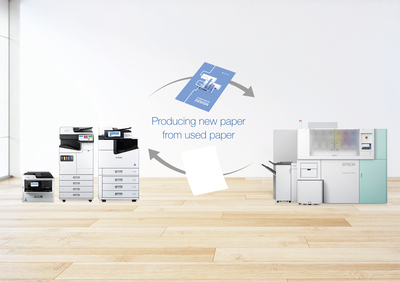
PaperLab is the world’s first in-office paper secure recycler that turns wastepaper into new paper using a virtually dry process powered by Epson’s unique Dry Fibre Technology. This groundbreaking solution stands to become one of the most significant developments in Epson’s history. PaperLab’s Dry Fibre Technology is not limited to paper and is also used in the manufacture of products including packaging, face masks and textile yarn.
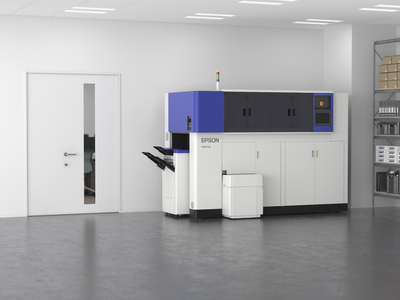
PaperLab is a real “watch this space” product that is scheduled to arrive in Australia in the not-too-distant future.
It was in 2023 that Epson achieved the transition to 100% renewable electricity at almost all Epson group sites worldwide3. With a total annual electricity consumption of approximately 876 GWh, this has resulted in a reduction in greenhouse gas (GHG) emissions of approximately 400,000 tonnes.
Earlier this year the Science Based Targets initiative (SBTi) approved Epson’s net-zero target and interim goals. This built on the company’s earlier target, approved in 2018, for well below 2°C and later raised to align with the 1.5°C goal.
Epson has also been recognised for its efforts and initiatives centred around sustainability by organisations including EcoVadis, FTSE4Good and the Responsible Business Alliance and it is also on the CDP A List for both climate change and water security.
The company has also established local partnerships with The Botanical Gardens of Sydney, Citizen Wolf, The Social Outfit, First Nations Fashion + Design and the Australian Fashion Council.
This year, Epson Australia also co-launched The Victorian Textile, Clothing and Footwear Manufacturing Report with the Australian Fashion Council and RMIT University. This critical report provides a strategic roadmap to revitalise and futureproof local manufacturing, identifying five key areas to boost productivity, cut waste and drive innovation through sustainable technology.
So, how to sum up Epson Australia and Epson NZ over the last 50 years, now and in the future?
As a global technology leader and the final link in a global value chain, Epson plays a vital role in driving the adoption of more sustainable technologies. Their energy-efficient technologies, space-saving designs and ultra-high precision helps reduce environmental impact while enriching communities.
By highlighting the practical advantages of these innovations, Epson enables people and businesses to work smarter, create with impact and operate more sustainably.
Over the last 50 years and moving forward, Epson’s purpose and values have driven and continue to drive innovation that delivers both sustainability and quality. These long-standing principles are central to the company’s success, informing decisions, shaping strategy and inspiring positive outcomes for their staff, customers and the environment.
Epson prioritises strong partnerships and customer-centric solutions and believes that what’s good for the planet is good for business.
Sustainability is at the heart of Epson’s purpose to create a better world and they have been committed to working with those who have shared their passion for building a more sustainable economy, environment and society for the last 50 years. Their future strategy, plans and goals clearly tell us that they wholeheartedly expect to do so for the next 50 and beyond.
1. Reduce emissions by at least 90% and then remove from the atmosphere an amount of CO2 corresponding to the remaining GHGs to then remove even more carbon.
2. Underground resource free means eliminating use of non-renewable resources such as oil and metals, except where such resources have been recycled.
3. Excludes some sales sites and leased properties where electricity use cannot be determined.
Follow Epson on social media:
LinkedIn: @Epson-Australia
Facebook: @EpsonAustralia
Twitter: @EpsonAust
YouTube: @EpsonAustralia
Instagram: @EpsonAust
How digital textile printing can rebuild local manufacturing in Australia
Digital print localises production, insulating brands from global supply volatility while...
From Vision to Impact: How Epson is turning environmental ambition into measurable action
As the global sustainability agenda accelerates, the challenge facing multinational organisations...
Rittal RiLineX — A standardised 60 mm busbar platform engineered for AS/NZS 61439 switchboards
It is designed to flex with real world requirements while staying consistent enough to repeat...