World record set for large-scale perovskite PV efficiency
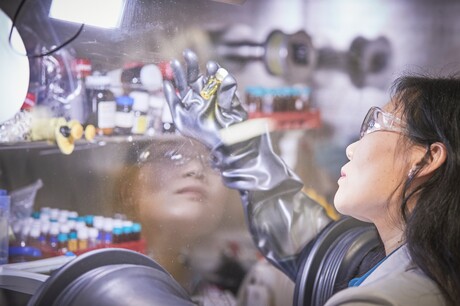
Engineers from UNSW Sydney have collaborated with high-tech energy company UtmoLight to set a benchmark for 676 cm2 perovskite solar submodules.
The UNSW team, led by Scientia Professor Xiaojing Hao, achieved a certified stabilised power conversion efficiency of 23.5%, beating the previous benchmark by 0.6 percentage points.
The result is particularly significant because it sets an efficiency benchmark for a 30 x 30 cm perovskite submodule, with an aperture area of 676 cm2, further narrowing the efficiency gap with small-area laboratory cells, which are typically only around 1 cm2.
Researchers said the world record demonstrates that perovskite solar technology can maintain high efficiency across much larger areas than laboratory-scale cells, highlighting its potential for scalable manufacturing and widespread use in photovoltaic modules.
“For us, this is not only about setting another efficiency record. It is about developing materials and device concepts that continue to perform when they are translated from laboratory cells to industrially relevant areas,” said Hao, from UNSW’s School of Photovoltaic and Renewable Energy Engineering.
“Materials that work exceptionally well in a small laboratory device do not necessarily behave in the same way under scaled-up processing conditions.
“Our focus is therefore not simply on finding high-performance materials, but on understanding how to design materials and interfaces that remain effective under the conditions required for large-area fabrication.”
In a further breakthrough, the UNSW–UtmoLight partnership achieved the world record result in combination with the removal of the conventional layer of nickel oxide which is commonly used in perovskite solar cells, and particularly in sub-module size, to help prevent electrical short circuits and ensure the device functions properly.
The UNSW team, which included Dr Zhen Li and Dr Ziyue Feng, used materials innovation — and a different approach to fabricating the solar cell — to eliminate the need for the nickel oxide layer, while also enabling a hole-selective contact to form directly during fabrication rather than through a conventional layer-by-layer process.
“Achieving high efficiency at this scale requires much more than simply transferring a laboratory process to a larger substrate,” Hao said.
“UtmoLight’s expertise in large-area processing and module fabrication has been essential in translating our materials and device concepts into a high-performance submodule.”
The collaboration between UNSW and UtmoLight allows the researchers to test the scalability of their ideas early in the development process, rather than spending years innovating materials that may not work at industrial scale.
This is important for future perovskite technologies, where the transition from laboratory research to large-scale manufacturing remains a key challenge.
“I think this partnership between UNSW and UtmoLight is very significant because it has allowed us to test and adjust our ideas at the very start of the process,” Hao said.
“We have been able to test our ideas to check if they can be upscaled, which means that we are not wasting our time on things that aren’t feasible.
“This is also good for industry as well, because they get to know whether there are innovations that can help them overcome some limitations in their large-scale processing systems.
“So we can see this is a good way to be able to test possible solutions at a very early stage of research and development.”
The researchers now hope to be able to scale up the efficiency testing even more in the next few months by producing a full-scale module with a 2.8 m2 area, representative of full-scale commercial PV module dimensions, to further validate their work.
They hope to achieve around 18–19% efficiency for that larger solar module, but acknowledge that further work is needed to improve efficiency, reproducibility and long-term stability before the technology can be widely deployed.
Hao was recently awarded $6.3m by the Australian Renewable Energy Agency (ARENA) to help continue her work to make perovskite–silicon solar panels more efficient and reliable.
Aussie startups receive LOI from PepsiCo
The startups brought solutions across logistics efficiency, sustainable agriculture, emissions...
UNSW HTH achieves highest sustainability rating
The 35,600-square-metre facility was developed to accelerate the translation of research and...
Fremantle Seaweed acquires onshore seaweed technology
The seaweed producer hopes to accelerate a path to commercial production by adding onshore...