Tiny molecule 'superhighways' to improve industrial processing
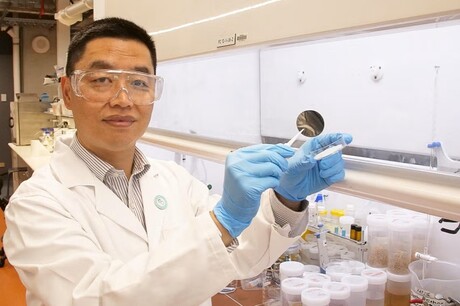
New membrane technology — delivering faster and more precise molecule separation — could improve the efficiency and sustainability of energy-intensive industrial processes, from purifying chemicals and recovering valuable resources to producing sustainable fuels.
University of Queensland chemical engineering researchers have developed technology that makes molecules move efficiently through membranes without impacting separation performance.
Chemical engineer Professor Xiwang Zhang, Director of the UQ Dow Centre for Sustainable Engineering Innovation and ARC Centre of Excellence for Green Electrochemical Transformation of Carbon Dioxide, said the breakthrough addressed a longstanding challenge in membrane technology.
“Allowing molecules to move faster while maintaining exceptional separation precision potentially reduces energy consumption in these industrial processes,” he said. “Industries need membranes that can process large volumes of materials quickly, while allowing only the desired molecules to pass through.
“But the faster molecules move through a membrane, the harder it becomes to separate them precisely.
“Overcoming this trade-off has been one of the biggest challenges in membrane science.”
To tackle the problem, researchers looked inside the membrane itself, focusing on tiny channels less than one nanometre wide, about 100,000 times thinner than a human hair.
“These channels are like ‘molecular highways’ and are a crucial component of membrane technology, yet often present frictional and adhesive barriers,” Zhang said. “It is very difficult to redesign this highway, so we asked a simple question: rather than just changing the size or chemistry of these highways, could we make them dynamic to help molecules move faster?
“Introducing self-rotating ammonium ions into the nanochannels could dramatically improve molecular transport.
“The natural mobility of the ammonia particles helped convert a once-rigid, static channel into a dynamic transport environment promoting improved energy transfer and efficient movement.
“The self-rotating molecules are like a turnstile that help us regulate molecular traffic accurately while keeping molecules moving quickly.
“Essentially we have upgraded the highways so that we get the best of both worlds: speed and selectivity.”
In ethanol and water separation experiments, researchers successfully demonstrated a tenfold improvement in separation accuracy compared with a standard filtration membrane.
“Our new membrane increased water transport by approximately 44%, and reduced ethanol by 90%,” Zhang said.
He said the next step would be to translate the technology into practical applications, including energy-efficient industrial separations, resource recovery, CO2 utilisation, and environmental protection.
The research has been published in Science.
AgenticScale launches distributed AI to support energy grid
The approach places smaller, modular computing facilities at suitable energy and industrial...
Aussie startups receive LOI from PepsiCo
The startups brought solutions across logistics efficiency, sustainable agriculture, emissions...
UNSW facility achieves highest sustainability rating
The 35,600-square-metre facility was developed to accelerate the translation of research and...