Biodiversity Standard launched to improve nature outcomes

Leaders from government, science, conservation, finance and industry gathered at the University of Queensland’s Customs House on Tuesday, 22 September 2026 for the official launch of the ENVOMARK-assured Australasian Biodiversity Improvement Standard (ABIS).
The Standard is designed to support high-integrity biodiversity projects and accelerate investment in nature-positive outcomes across Australasia.
By establishing clear requirements for project design, monitoring, reporting and independent verification, the Standard is intended to build confidence among landholders, project developers, communities, governments and investors seeking credible biodiversity outcomes.
Amy Basnett, Head of Programs at Eco-Markets, presented on the purpose of the Standard, its alignment with emerging Australian and international nature-positive policy frameworks, and its role within expanding global voluntary biodiversity credit markets.
“ABIS is the newest addition to Eco-Markets’ suite of integrated ENVOMARK-assured Standards which provide a high-integrity framework to deliver verified outcomes achieved for nature, converted into credits which can be purchased for both ESG and compliance purposes,” Basnett said.
Her presentation highlighted the growing economic opportunity associated with biodiversity investment. According to Bloomlabs, the global voluntary biodiversity credit market has experienced approximately 22% growth since 2022 and generated an estimated US$7 million in revenue.
Projections from the International Emissions Trading Association (IETA) and Goldman Sachs suggest the market could expand to between US$2 billion and US$5 billion by 2030.
“The opportunity to scale voluntary biodiversity markets alongside compliance mechanisms is real,” she said. “Countries around the world are introducing policy levers to halt and reverse biodiversity loss, creating demand for credible, measurable and verifiable biodiversity outcomes. ABIS positions Australasia to participate in that global transition, and aligns with government initiatives such as the Nature Repair Market, Australian Carbon Credit Market and Biodiversity Offset Scheme.”
A panel discussion moderated by Eco-Markets’ CEO, Dr Goslik Schepers, led an engaging conversation on the future of biodiversity credits, environmental integrity and nature finance.
The panel featured Dr Karen Hussey, Chair of the Emissions Reduction Assurance Committee (ERAC); Professor Martine Maron, conservation scientist in UQ’s School of the Environment; Tom Espinoza, CEO of the Burnett Mary Regional Group and a quantitative ecologist; and Nerida Bradley, an experienced environmental markets, policy and governance leader with Planet & Place.
The session discussed the role of markets to support nature repair and restoration, emphasising that Australia has a leadership position with existing strong institutions, quality scientific rigour and globally respected market infrastructure ready to support scalable nature repair.
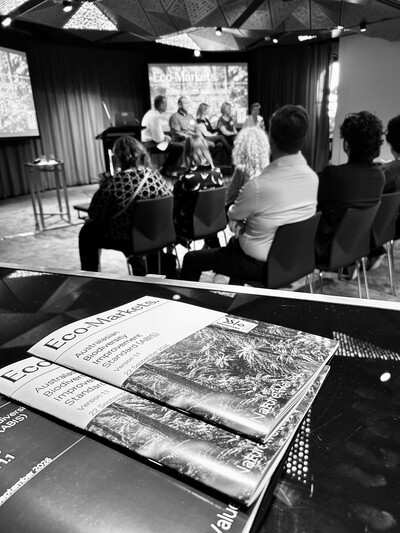
Backed by emerging government regulations that recognise environmental markets, the panel reflected on the role of voluntary markets to sit alongside government-regulated initiatives to deliver high-integrity solutions that are needed to stem the decline in Australia’s natural capital.
“It was a privilege to coordinate a conversation with such experienced and delightful panel members. Their clarity of thought and openness to discuss complex and sometimes controversial topics made my job easy on the night,” Schepers said.
Some key takeaways from the session included responses on human reciprocal responsibilities to nature, improving threatened species habitat because ‘it’s the right thing to do’, and that there are no ‘landowners’, just temporary stewards whose actions are passed through to future generations.
Discussions also reflected a broader shift globally, with biodiversity loss considered alongside climate change as a critical risk for governments, investors and businesses.
As nature-positive policies become favourable in an attempt to reverse the damage, demand is expected to grow for approaches that can verify environmental outcomes and attract meaningful corporate investment in conservation action.
Event speakers emphasised that biodiversity markets are not a replacement for traditional conservation funding, but rather an opportunity to mobilise additional private capital to complement public investment and support long-term stewardship of ecosystems and species.
Read the full ABIS Guide here.
Boral launches detailed carbon reporting capability
The company said the automated reporting capability eliminates the need to manually compile...
Epson MD serves meals for CEO CookOff
The OzHarvest CEO CookOff will bring together business leaders, chefs and corporate teams to...
World record set for large-scale perovskite PV efficiency
UNSW has collaborated with a high-tech energy company to set a benchmark for 676 cm2...