Renewables supply reaches almost 50% on Aust's east coast
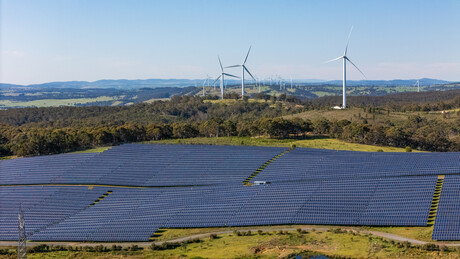
Australia’s east coast electricity system has been affected by renewable generation growth and rising battery participation in the first quarter of 2026, alongside a year‑on‑year decline in wholesale prices, according to AEMO’s Quarterly Energy Dynamics (QED) report.
The report stated that in the National Electricity Market (NEM), renewables supplied 46.5% of generation, the highest share on record for a first quarter, driven by increased wind and solar output, with batteries playing a greater role in market.
Underlying electricity demand across the NEM reached a record of 25,496 MW according to the report, up 1.2% on the same period last year. However, record distributed rooftop solar output offset this growth, leaving operational demand broadly unchanged.
AEMO’s Executive General Manager Policy & Corporate Affairs, Violette Mouchaileh, said the quarter highlighted how energy storage and renewables are increasingly shaping electricity market outcomes.
“The significant increase in large‑scale and household battery capacity is changing how electricity is produced, consumed and priced across the day,” Mouchaileh said. “Grid-scale batteries are increasingly absorbing excess renewable energy during the day and shifting it into the market during evening peaks, helping moderate prices during high-demand periods.”
During the quarter, batteries more than tripled their daytime-to-evening energy shifting, delivering 1115 MW into the evening peak. This surge was enabled by 4445 MW of new battery capacity added over the past 12 months, more than doubling total installed capacity.
“Batteries were the most frequent price‑setting technology, setting prices in around 32% of trading intervals across the NEM during the quarter. They increasingly reduced reliance on gas and hydro generation during evening peaks, contributing to lower year‑on‑year wholesale prices in most regions,” Mouchaileh said.
While summer heat events saw prices spike higher than Q4 2025, the NEM average wholesale electricity price for Q1 was $73 MWh, down 12% compared to the same time last year.
The report stated that grid-scale solar generation averaged 2706 MW, up 13% year-on-year, while wind generation averaged 3845 MW, supported by new projects and those commissioning to full output, particularly in Queensland. Coal-fired generation declined to a new first-quarter low, while gas-powered generation fell to its lowest quarterly average since 1999.
The QED included insights into data centre connections across the NEM for the first time, with 11 large-scale projects (>5 MW) representing 5.4 GW of maximum demand progressing through the transmission connection process in Q1. Around 60% of capacity is in New South Wales and 40% in Victoria, with most projects in early stages, including seven in the application phase (4.1 GW) and four in proponent implementation (1.3 GW).
In the East Coast Gas Market, wholesale gas prices averaged $10.61/GJ, down 20% from a year earlier and reaching a four‑year low in March at $9.22/GJ.
“Despite elevated international liquefied natural gas (LNG) prices linked to geopolitical uncertainty, domestic gas prices fell, supported by lower gas demand for electricity generation and reduced Queensland LNG exports,” Mouchaileh said.
In Western Australia, the renewable share of generation in the Wholesale Electricity Market (WEM) increased to 46.1%, up from 40.8% in Q1 2025, supported by higher wind output, increased distributed photovoltaic (PV) output, and a rise in biomass generation.
“Similar to the NEM, the growth in renewables and grid‑scale batteries — with more than 1000 MW of battery capacity added in the past year — is changing the dynamics of Western Australia’s WEM,” Mouchaileh said.
The sum of all normalised costs in the WEM was $147.03/MWh in Q1, an increase of $2.10/MWh (+1%) from Q1 2025.
Western Australia’s domestic gas consumption was 97.4 petajoules (PJ), a decrease of 4.7 PJ (-4.6%) compared with Q1 2025, while production was 97.3 PJ, which represented a 4.1 PJ (-4.0%) decrease.
“While impacts from reduced access and higher costs for diesel are having an impact on market participants, consumers and the economy more broadly, Australia’s electricity and gas markets remain resilient, with strong gas storage levels heading into winter. AEMO continues to support industry and advise governments,” Mouchaileh said.
For the full Quarterly Energy Dynamics report, visit the AEMO website.
ACCC guidance on emissions claims to consumers released
The guidance aims to assist businesses in making accurate, credible emissions claims and to...
Industry transitions from gas to renewable heat: report
More than 230 Australian industrial sites and commercial buildings will have switched from gas to...
Industrial electricity costs could halve by sharing infrastructure
Heavy industry could reduce electricity costs by up to 50% by sharing renewable infrastructure...