Novel energy storage system to decarbonise buildings
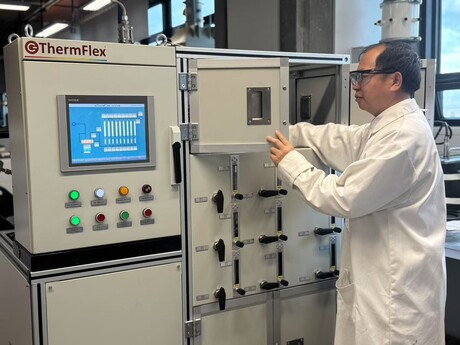
University of Birmingham researchers have designed a novel energy storage system that charges from surplus renewable power that would otherwise be wasted, and delivers heat or cooling when required.
Developed by Professor Yongliang Li, Chair in Thermal Energy Engineering at the School of Chemical Engineering, the compact system is intended for buildings where traditional appliances such as heat pumps are impractical, and has been demonstrated at lab scale with a 5 kW demonstrator unit that responds intelligently to smart tariffs and grid signals.
The system uses advanced thermochemical materials that have dramatically higher energy densities than conventional systems. Early analysis has shown commercial adopters can expect lower upfront and running costs than existing systems.
“Thermochemical storage differs from classical methods of heat storage such as hot water tanks, where there is significant energy loss as the water temperature falls to meet the ambient temperature,” Li said. “Thermochemical storage behaves more like a fuel: it is triggered by a chemical reaction, so there is no loss during storage, offering higher energy density and long-term storage capability.
“The race to decarbonise commercial buildings is intensifying. One of the biggest challenges is how to deliver low-carbon heating and cooling without overwhelming the electricity grid or pushing up cost.
“The increased generation of zero-carbon power, means the limiting factor is now the flexibility of energy storage systems that unlock the full value of clean energy, by storing energy when electricity is cheap and abundant and releasing it when buildings actually need it.”
The research team is working with a UK company to develop a fully integrated system for demonstration at a practical scale, and University of Birmingham Enterprise is now seeking further commercial partners to pilot the system in energy-intensive commercial settings, in sectors such as HVAC, manufacturing and engineering, or commercial building management.
ACCC guidance on emissions claims to consumers released
The guidance aims to assist businesses in making accurate, credible emissions claims and to...
Industry transitions from gas to renewable heat: report
More than 230 Australian industrial sites and commercial buildings will have switched from gas to...
Industrial electricity costs could halve by sharing infrastructure
Heavy industry could reduce electricity costs by up to 50% by sharing renewable infrastructure...