Ferrocene could be key to next-gen grid-storage batteries
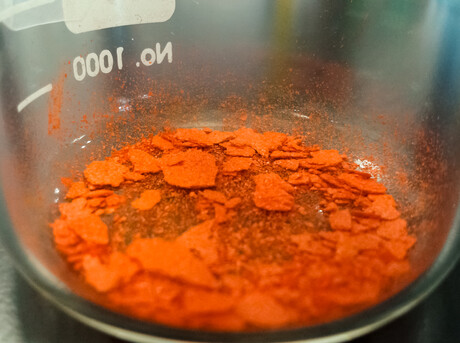
An orange solid with a camphor-like odour has helped aqueous zinc-iodide batteries move a large step closer to supplying safe and economic grid and household energy storage.
Researchers from the ARC Centre of Excellence for Carbon Science and Innovation based at Adelaide University have used ferrocene, an electroactive cation and that orange, camphor smelling solid, to solve two key problems plaguing the ability of the aqueous zinc-iodide battery to become an alternative energy storage source to lithium-ion batteries: the shuttling effect of reaction intermediates that corrode the anode and the need to boost energy density.
Rechargeable zinc (Zn) aqueous batteries have attracted attention because of their low cost, affordable energy density and high safety. Porous carbon materials in zinc-iodide (Zn-I) batteries, which feature high electronic conductivity and physical adsorption, make them suitable to host iodine to improve the reversibility (charge-discharge) of Zn-I batteries.
The problem is that in Zn-I batteries, the I-/I2 conversion generates soluble polyiodides (essentially a string of iodine atoms) that shuttle to the anode on cycling leading to corrosion of the Zn anode and significant self-discharge.
The porous carbon has typically been used to confine the polyiodides, but this adsorption is weak and shuttling effects cannot be completely avoided. Limiting the amount of iodide in the porous carbon has been used as a trade-off, but that compromises the energy density. Other cations employed to confine the polyiodides have been electrochemically inactive.
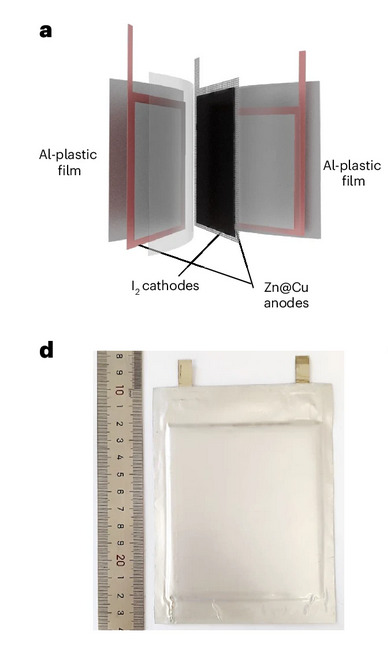
Image credit: ARC Centre of Excellence for Carbon Science and Innovation.
“The ferrocene effectively captures the polyiodides transforming the soluble polyiodide-mediated liquid phase into an insoluble ferrocenium–polyiodide complex that stops the shuttling effect,” Qiao said.
Without ferrocene, it is only the iodine that provides the energy capacity. But the ferrocene–ferrocenium redox improves the active mass ratios of iodine cathodes from the typically less than 70% in traditional porous carbon to 90%, which has significantly enhanced the energy density and minimised capacity loss of the batteries.
“This value surpasses reported Zn-I batteries. Our Zn-I batteries also surpass traditional aqueous systems in both energy density and lifespan, demonstrating its great potential in commercial application,” Qiao said.
In addition, Zn-I has very long-term cycling stability that is superior to the Li-ion battery, which will further reduce the overall cost of the batteries.
“As we seek greater reliance on batteries for storage of grid energy, the safety concerns and high cost of Li-ion batteries is creating opportunities for alternative technologies. Aqueous batteries are cheaper, stable and therefore safer, are recyclable and have a longer lifespan,” Qiao said.
“The introduced functional redox materials that reconciled shuttle suppression with high energy density, offers a promising route to the development of advanced aqueous Zn–I2 batteries.
“We still have a lot of work to do before commercialisation. At the fundamental level, we are working on improving the energy density further and we are exploring the ability to scale up the system from the ampere-hour (Ah) Zn–I2 pouch cells.”
The research is published in Nature Chemistry.
Phone:
IFS Zero agentic emissions operating system
The system provides a single, unified calculation platform that enables organisations to measure,...
ABB Battery Energy Storage Systems-as-a-Service
ABB has launched its new BESS-as-a-Service — a flexible, zero-CapEx solution...
Mitsubishi Electric FR-D800 series inverters
The FR-D800 series inverters are designed for a range of industrial applications.